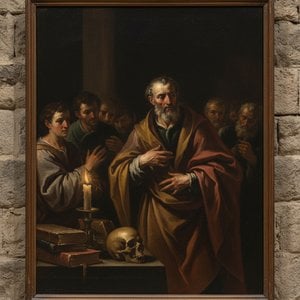
The Grandeur of the Spanish Baroque: The Life of Francisco Rizi
Francisco Rizi de Guevara, a name synonymous with the theatrical splendor of the seventeenth-century Spanish Golden Age, lived a life that mirrored the very drama he captured on canvas. Born in Madrid around 1608, Rizi was destined for a life steeped in the arts. He was the son of Antonio Ricci, an Italian painter from Ancona who had traveled to Spain to contribute to the magnificent decorations of El Escorial. This lineage provided Francisco with an early immersion in the technical rigors of the craft, as he began his journey within his father's workshop. His upbringing was not merely one of domestic instruction but a profound introduction to the international currents of style flowing through the Spanish court, blending Italian precision with the burgeoning energy of the Spanish Baroque. The trajectory of Rizi’s talent was further shaped by his apprenticeship under the esteemed Vicente Carducho. From Carducho, Rizi inherited a mastery of disegno—the foundational principle of careful anatomical accuracy and structural integrity. This mentorship was transformative, providing him with the technical vocabulary to navigate the complex demands of royal and religious patronage. As he matured, Rizi’s ability to weave together meticulous realism with an expressive, emotive color palette allowed him to ascend the social and artistic hierarchies of Madrid, eventually securing influential positions such as the deputy keeper of the royal keys under Charles II and prestigious commissions for the Cathedral of Toledo.A Master of Spectacle and Devotion
Rizi’s oeuvre is a breathtaking tapestry of the sacred and the secular, characterized by an unparalleled ability to stage monumental events. He was not merely a painter but a visual storyteller who understood the power of spectacle. His work often bridged the gap between the divine and the earthly, as seen in his religious compositions where light and shadow dance to evoke deep piety. In works such as his Annunciation, one can witness the profound mastery of atmosphere, where the divine revelation is rendered with a palpable sense of weight and grace, inviting the viewer into a moment of sacred intimacy. Beyond the altar, Rizi possessed a unique gift for capturing the pulse of Madrid itself. He was a master of the historical scene, capable of transforming a canvas into a sprawling stage for the city's most significant public rituals. His monumental masterpiece, Auto-da-fé on Plaza Mayor, Madrid, stands as a testament to this skill. In this vast composition, Rizi captures the dizzying energy of a religious ceremony in the heart of the capital, populating the square with a diverse crowd ranging from the highest nobility to the common citizenry. Through his use of oil on canvas, he achieved a level of texture and depth that makes the architecture of the plaza feel almost tangible, immortalizing the social and religious fabric of 1683 Spain.Legacy and Artistic Significance
The historical significance of Francisco Rizi lies in his versatility and his role as a bridge between different artistic traditions. He was an artist who could navigate the rigid requirements of courtly portraiture—as seen in the elegant Equestrian Portrait of Marie Louise d’Orléans—while simultaneously embracing the fluid, dramatic impulses of stage design and theatrical production. This multifaceted talent allowed him to contribute significantly to the decorative arts of the Spanish monarchy, ensuring that the visual identity of the era was one of both majesty and movement. Today, Rizi is remembered as a pivotal figure who helped define the aesthetic of the Spanish Baroque. His ability to synthesize the technical discipline of his Italian heritage with the emotive power required by the Spanish Church and Crown created a legacy of profound impact. His works, now preserved in world-renowned institutions like the Museo del Prado, continue to captivate audiences, offering a window into a vanished world of ritual, grandeur, and unyielding faith. Through his brush, the history of Madrid and the soul of the Baroque era remain vibrantly alive.Q&A
Francisco Rizi의 작품 중 몇 점을 둘러보실 수 있나요?
전체 작품 보기 페이지에서 Francisco Rizi의 작품 작품 10점점을 만나보실 수 있습니다.
Francisco Rizi 작가의 작품 관련 통계 정보는 어디에서 확인할 수 있나요?
Francisco Rizi 작가의 작품 통계 정보는 방문 통계 페이지에서 확인하실 수 있습니다.
주제별로 분류된 Francisco Rizi의 작품들은 어디에서 확인할 수 있나요?
Francisco Rizi의 주제별 작품 모음는 작가의 작품들을 주제별로 찾아볼 수 있는 페이지입니다.