Francesco Bonsignori: A Veronese Master of Devotion and Subtle Realism
Francesco Bonsignori (c. 1455 – July 2, 1519), a name often debated until recently due to the striking similarities in technique between his work and that of his influential teacher, Mantegna, represents a pivotal figure in the late Northern Renaissance art of Italy. Born in Verona, amidst a family steeped in artistic tradition—his father, Albertus Bonsignori, was himself an amateur painter—Francesco’s early life was marked by exceptional talent, nurtured under the tutelage of Liberale da Verona, a miniaturist who skillfully adapted Mantegna's innovative style to a larger scale. This formative period established a foundation built upon Venetian influences – subtle color palettes and atmospheric backgrounds hinting at the artistic currents flowing through the region.
Bonsignori’s career truly blossomed during his time in Mantua, serving as a court artist for the Gonzaga family from 1487. This patronage provided him with unprecedented opportunities to develop his skills and explore diverse subjects. Initially, he worked closely with Andrea Mantegna, collaborating on numerous religious paintings that showcased a shared aesthetic—a meticulous attention to detail, a restrained emotionality, and a masterful use of perspective. However, as Bonsignori’s own style matured, it began to diverge from Mantegna's, incorporating elements influenced by Lorenzo Costa, particularly in the realm of form and color. This shift is most evident in his later works, notably the monumental altarpiece, “The Adoration of the Blessed Osanna Andreasi” (Palazzo Ducale, Mantua), completed shortly before his death – a testament to his artistic prowess and a culmination of decades of dedicated practice.
Bonsignori’s early artistic development is remarkably well-documented, largely thanks to Giorgio Vasari's seminal work, *Lives of the Most Excellent Painters, Sculptors, and Architects*. Vasari highlights Bonsignori’s prodigious talent within his family, noting that he was the most artistically gifted among his brothers, Bernardino and Girolamo. Girolamo, in particular, is celebrated for his exquisite copy of Leonardo da Vinci's *Last Supper*, a remarkable feat of artistic imitation demonstrating a deep understanding of the master’s techniques. This familial legacy undoubtedly contributed to Bonsignori’s own dedication to his craft.
The Influence of Liberale da Verona and Mantegna
Bonsignori’s early training under Liberale da Verona proved crucial in shaping his artistic sensibilities. Liberale, initially a miniaturist, was deeply influenced by Mantegna's innovative approach to perspective, composition, and the depiction of human figures. This influence is readily apparent in Bonsignori’s early works, characterized by a meticulous attention to detail and a sophisticated understanding of spatial relationships. Furthermore, Bonsignori’s appreciation for Francesco Squarcione, the founder of the Paduan school and a key teacher of Andrea Mantegna, further solidified his connection to this influential artistic lineage.
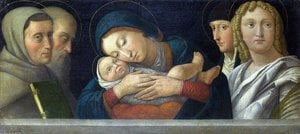
The collaboration with Mantegna during his time at the Gonzaga court was particularly formative. They jointly executed numerous religious paintings, often exploring themes of the Madonna and Child, demonstrating a shared commitment to realism and devotional intensity. Mantegna’s influence is palpable in Bonsignori's later works, particularly in his use of light, shadow, and anatomical accuracy – elements that contribute to the profound emotional impact of his compositions.
A Master of Religious Painting and Portraiture
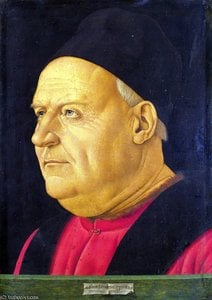
While Bonsignori is primarily recognized for his contributions to religious painting—altarpieces, devotional panels, and frescoes—he also excelled in portraiture. His portraits, often commissioned by the Gonzaga family, are notable for their subtle realism and psychological depth. He skillfully captured the personalities of his subjects, conveying a sense of dignity and grace through carefully observed details and nuanced expressions.
Bonsignori’s artistic versatility is further evidenced by his architectural perspective skills. His ability to render buildings with remarkable accuracy—a skill honed during his time in Mantua—is particularly evident in works such as “The Adoration of the Blessed Osanna Andreasi,” where he seamlessly integrates architectural elements into the overall composition, creating a sense of spatial coherence and grandeur.
Late Style and Legacy
Bonsignori’s late style is characterized by a decisive shift towards the aesthetic principles championed by Lorenzo Costa. This influence is most evident in his use of color—rich, luminous hues that create a vibrant and emotionally resonant atmosphere. His compositions also exhibit a greater sense of dynamism and movement, reflecting a growing confidence and artistic maturity.
Despite his relatively short career – he died in 1519 – Francesco Bonsignori left behind a significant body of work that continues to captivate art historians and enthusiasts alike. His paintings are valued for their technical skill, emotional depth, and subtle realism—qualities that firmly establish him as one of the most important artists of the late Northern Renaissance.