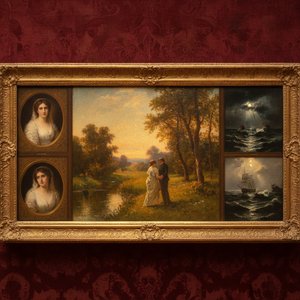
A Quiet Presence in Portraiture
Florence White lived a life shaped by the steady rhythms of the South Coast. Born in Steyning, East Sussex, she grew up in a household where language and learning held weight; her father was a schoolmaster who taught English to a Tsar. By the time she was a young woman in Hove, she had found her way into the local art school classes of Brighton. She did not seek the loud, sweeping movements of her era, but instead focused her attention on the small, the intimate, and the human. Her hands were accustomed to the delicate precision required for miniatures and the careful observation needed for portraits.
Her work appeared in the galleries and publications of the late Victorian and Edwardian periods. She was a regular presence in the Royal Academy and the Society of Lady Artists, showing her skill to a public that valued the subtle nuances of a face. There was a specific kind of patience in her approach, a way of looking at her subjects that favored the truth of a person over a grander, more theatrical presentation. She moved through the art world of the time with a quiet, consistent professionalism, exhibiting her work from 1881 through 1917.
The Details of a Life in Paint
The practice of a portraitist requires a certain stillness. White found her niche in capturing the likenesses of women and children, often working in mediums that demanded a steady hand and a keen eye for light. Her studio was located on Redcliffe Road, a place where the quiet work of painting could take place away from the bustle of the larger cities. Her technical skill was recognized by her peers and through various exhibitions, including:
- The Society of British Pastellists
- The Society of Portrait Painters
- The Calcutta Art Society
- The Society of Lady Artists
In 1923, she received a medal for a best life-size head from the Calcutta Art Society, a recognition of her ability to capture the essence of a subject in any medium. This achievement speaks to a career built on the ability to translate a living presence onto a surface, whether through the expansive brushwork of a portrait or the tiny, meticulous details of a miniature.
Legacy and Recognition
While much of her life remains tucked away in census records and old exhibition lists, her contribution to the art of the period is documented in the pages of Women Painters of the World. Her work, such as White Treasures, remains a part of the historical record of British portraiture. She was part of a generation of women artists who carved out professional spaces for themselves, navigating the requirements of the Royal Academy and various societies with a steady, practiced hand. She passed away in 1932, leaving behind a body of work that captures the faces and the quiet dignity of her time.
Q&A
Florence White의 작품을 컬러 팔레트별로 둘러볼 수 있나요?
Florence White의 작품은 작가의 컬러 팔레트별로 보기 페이지에서 컬러 팔레트별로 만나보실 수 있습니다.
Florence White의 작품을 매체별로 찾아볼 수 있나요?
모든 매체별 페이지에서는 Florence White의 작품을 기법별로 모아볼 수 있습니다.
키워드별로 분류된 Florence White의 작품은 어디에서 볼 수 있나요?
특정 주제의 Florence White 작품을 찾으려면 키워드별로 작품이 분류된 작가의 키워드별 탐색 페이지를 이용해 보세요.
Florence White의 연도별 활동 기록이 있나요?
Florence White의 연대기는 작가의 활동 시기별로 분류된 작품들을 연대순으로 보여주는 스크롤 방식의 타임라인입니다.