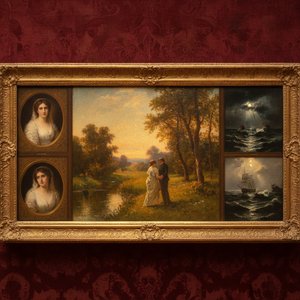
The Luminous Legacy of Federico Olaria
In the grand tapestry of nineteenth-century art, few names evoke the quiet, evocative charm of Federico Olaria. Born in 1848, Olaria emerged during a transformative era when the boundaries of classical tradition were beginning to soften under the influence of light and atmosphere. His life, spanning the late Victorian period until his passing in 1898, was defined by a profound devotion to capturing the ephemeral beauty of the natural world. To study Olaria’s work is to step into a realm where time seems to slow, allowing the viewer to witness the delicate interplay of shadow and sunbeam as if they were occurring in real-time.
Olaria’s artistic journey was characterized by an unwavering commitment to the nuances of light. While many of his contemporaries sought to capture grand historical narratives or monumental figures, Olaria found his muse in the subtle transitions of the landscape. His technique relied heavily on a sophisticated understanding of color temperature, using soft, blended brushstrokes to create a sense of depth and airiness. This mastery allowed him to render the misty mornings of the countryside and the golden hues of twilight with an intimacy that feels both deeply personal and universally resonant.
Technique and Artistic Vision
The brilliance of Olaria’s oeuvre lies in his ability to balance structural precision with atmospheric fluidity. His approach to the canvas was never merely about documentation; it was about emotion. Through his use of chiaroscuro and a delicate palette, he could imbende even the simplest pastoral scene with a sense of profound tranquility or melancholic beauty. His development as an artist saw him moving away from rigid, academic outlines toward a more impressionistic sensibility, where the texture of the paint itself contributed to the tactile reality of the subject matter.
Key elements that define his artistic signature include:
- Atmospheric Perspective: The masterful use of receding tones to create an illusion of vast, infinite space within a two-dimensional plane.
- Luminous Color Palettes: A preference for soft pastels and warm earth tones that mimic the natural glow of sunlight filtering through foliage.
- Emotional Resonance: An ability to evoke nostalgia and peace through the depiction of quiet, undisturbed landscapes.
Historical Significance and Enduring Influence
Though his life ended in 1898, the impact of Federico Olaria continues to ripple through the appreciation of landscape art. He stands as a bridge between the formal rigor of mid-century realism and the emotive freedom of the burgeoning Impressionist movement. His work serves as a vital historical record of the aesthetic sensibilities of his time, capturing a world that was on the precipice of rapid industrial change. By focusing on the timelessness of nature, Olaria provided a sanctuary of stillness for his audience.
Today, collectors and art historians alike look to Olaria not just for his technical prowess, but for the soul he breathed into every landscape. His paintings remain much more than mere depictions of scenery; they are windows into a lost era of grace and quietude. The enduring legacy of Federico Olaria is found in every brushstroke that seeks to capture the fleeting magic of a sunset or the gentle whisper of the wind through the trees, ensuring his place in the pantheon of masters who taught us how to truly see the world.
Q&A
Federico Olaria 작가의 다른 활동명이나 알려진 이름이 있나요?
Federico Olaria은(는) Frederico Olaria라는 이름으로도 활동하고 있습니다.
Federico Olaria 작가의 작품 관련 통계 정보는 어디에서 확인할 수 있나요?
이 사이트에서 Federico Olaria의 작품에 관한 통계를 확인할 수 있는 방문 통계 페이지를 만나보세요.
Federico Olaria의 작품을 색상별로 모아둔 곳은 어디인가요?
Federico Olaria의 작품은 작가의 컬러 인덱스 페이지에서 색상별로 감상하실 수 있습니다.
키워드로 Federico Olaria의 작품을 찾아볼 수 있나요?
특정 주제의 Federico Olaria 작품을 찾으려면 키워드별로 작품이 분류된 작가의 키워드별 탐색 페이지를 이용해 보세요.