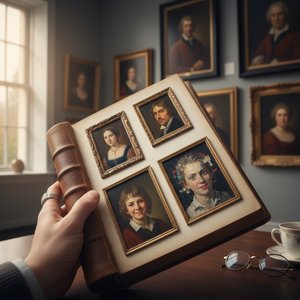
A life in miniature
Fanny Charrin lived her days between the quiet focus of a studio and the busy streets of Paris. Born in Lyon around 1781, she moved within a family where art was a shared language, alongside her sister Sophie. Her hands learned the delicate precision required for portrait miniatures through the guidance of Étienne-Charles Le Guay and Jean-Baptiste Jacques Augustin. The latter became more than a teacher; he was a friend whose influence can be seen in the way she approached the small, intimate surfaces of ivory.
Her studio at 20 Rue Neuve d'Orléans sat near the Porte Saint-Denis, a place where she worked on tiny, detailed faces. She did not merely paint portraits; she applied her skill to porcelain as well. Between 1814 and 1826, her work found its way onto pieces produced for the Sèvres porcelain manufactory. These painted figures required a steady hand and an eye for the subtle shifts in light that define a person's gaze.
The precision of the brush
The work Charrin left behind shows a preoccupation with the small-scale. She worked often with watercolor, gouache, and enamel on ivory. There is a specific weight to her subjects, even when they are rendered in a space no larger than a few centimeters. In her portraits, one finds a focus on the way a gaze meets the viewer, an emotional pull that comes from the careful placement of a single stroke.
Her technical range extended across different materials and formats:
- Miniatures painted on ivory, often capturing bust-length figures.
- Painted figures on porcelain for the Sèvres manufactory.
- Enamel works that captured the texture of fabrics like pink silk or gold scarves.
- Watercolor and gouache portraits that documented her own likeness and those of her contemporaries.
Recognition and presence
Charrin’s presence in the Parisian art scene was marked by regular appearances at the Art Salons. She exhibited in 1806, 1808, 1810, 1812, 1814, 1822, and 1824. These exhibitions allowed her small-scale works to be seen by a wider audience. In 1831, at the Fine Arts exhibition in Valenciennes, she received a bronze medal for her miniatures, which were noted for their fine finish and well-drawn figures.
Her life in Paris was lived with a certain independence. She resided at home on Rue du Faubourg-Poissonnière and maintained her practice by providing private lessons to others. While her earnings fluctuated—reaching 2,440 francs in 1818 before dropping to much lower amounts in later years—she remained a fixture of the miniature painting community until her death in Paris on 5 July 1854.
Q&A
키워드별로 분류된 Fanny Charrin의 작품은 어디에서 볼 수 있나요?
Fanny Charrin의 작품은 아티스트의 키워드별 탐색 페이지에서 키워드별로 찾아보실 수 있습니다. 각 키워드를 통해 관련 작품들을 모아 감상하실 수 있습니다.
Fanny Charrin의 예술 세계는 시간이 흐름에 따라 어떻게 진화했나요?
Fanny Charrin의 연대기는 작가의 활동 시기별로 분류된 작품들을 연대순으로 보여주는 스크롤 방식의 타임라인입니다.
Fanny Charrin의 작품을 매체별로 찾아볼 수 있나요?
모든 매체별 페이지에서는 Fanny Charrin의 작품을 기법별로 모아볼 수 있습니다.
Fanny Charrin의 작품 중 몇 점을 둘러보실 수 있나요?
전체 작품 보기 페이지에서 Fanny Charrin의 작품 작품 1점점을 만나보실 수 있습니다.