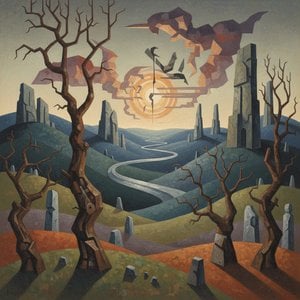
Eustace P. E. Nash: Capturing Dorset’s Soul
Eustace Pain Elliott Nash (1886-1969) wasn't a name that immediately resonates within the grand halls of art history, yet his canvases hold a quiet power—a profound ability to distill the essence of the English countryside, particularly the rugged beauty of Dorset. Born in Boscombe, a coastal town near Bournemouth, Nash’s early life was steeped in the Victorian atmosphere of a burgeoning seaside resort, an environment that would profoundly shape his artistic vision. Unlike many artists who sought grand narratives or dramatic historical scenes, Nash dedicated himself to meticulously observing and rendering the everyday landscapes and portraits of his region, creating a remarkably intimate and deeply personal body of work.
His formal training at the Bournemouth School of Art provided him with a solid foundation in watercolor techniques, but it was his independent exploration of Dorset’s rolling hills, dramatic coastlines, and charming villages that truly defined his style. Influenced by the Impressionists' focus on light and color, Nash developed a distinctive approach—a delicate layering of washes, precise detailing, and an almost photographic realism combined with a subtle atmospheric quality. He wasn’t merely depicting scenes; he was attempting to capture the *feeling* of Dorset – its dampness, its warmth, its timelessness.
A Career Bridging Commercial Art and Artistic Pursuit
Nash's artistic journey wasn't one of solitary dedication. He began his career as a commercial artist, working for Bournemouth’s publicity department and producing illustrations for local publications. This practical experience honed his observational skills and taught him the importance of capturing the essence of a subject quickly and effectively. However, he never abandoned his passion for painting, dedicating much of his free time to developing his artistic style. This dual existence—the pragmatic artist supporting himself through commercial work alongside the dedicated painter—allowed him to maintain an unwavering focus on his craft.
His illustrations for the *Bournemouth Graphic*, a weekly newspaper, are particularly noteworthy. These weren’t grand landscapes but rather charming depictions of local characters and scenes – fishermen mending nets, children playing in the streets, and bustling market stalls. These works demonstrate Nash's ability to capture the spirit of everyday life with remarkable accuracy and affection. He also collaborated closely with Leslie Ward, another prominent Bournemouth artist, forming a significant artistic partnership that further enriched the local art scene.
The Dorset Landscape: A Detailed World
Nash’s most celebrated work revolves around his depictions of Dorset. He produced countless paintings showcasing the region's diverse landscapes – from the dramatic cliffs of Lulworth Cove to the tranquil meadows surrounding Poole Harbour. His approach was remarkably detailed, meticulously rendering every blade of grass, every ripple in a stream, and every weathered stone. Yet, he never lost sight of the larger composition, creating scenes that are both intimate and expansive.
Notable works like “Pantomime People” (1934) offer a glimpse into the vibrant social life of Bournemouth, capturing the energy and excitement of theatrical performances with remarkable precision. Similarly, "Bus Interior Scene" (1930) provides a fascinating snapshot of urban life in the early 20th century, portraying the bustling activity within a Dorset bus with an almost documentary-like quality. These paintings aren’t simply representations of places; they are windows into a specific time and place, imbued with a sense of nostalgia and affection.
Legacy and Historical Context
Eustace Nash's work is often considered part of the broader British watercolor movement of the early 20th century. While he shared stylistic similarities with artists like Paul Nash (a fellow Dorset-based painter), his focus on regional landscapes and everyday life distinguished him as a unique voice. His paintings offer valuable insights into the social and cultural landscape of Dorset during a period of significant change – from the Victorian era to the rise of tourism and modernity.
Interestingly, Nash’s work has been linked to broader artistic currents, including the influence of Impressionism and a subtle engagement with modernist ideas. His meticulous observation and attention to detail can be seen as a response to the rapidly changing world around him, while his evocative use of light and color reflects a deep appreciation for the beauty of the natural world. Today, Nash’s paintings are cherished for their technical skill, their atmospheric quality, and their enduring portrayal of Dorset's timeless charm.
Q&A
Eustace P. E Nash의 작품 중 몇 점을 둘러보실 수 있나요?
전체 작품 보기 페이지에서 Eustace P. E Nash의 작품 작품 12점점을 만나보실 수 있습니다.
Eustace P. E Nash의 예술 세계는 시간이 흐름에 따라 어떻게 진화했나요?
Eustace P. E Nash의 작품 세계를 시간순으로 정리한 기록은 아티스트 연대기 페이지에서 확인하실 수 있으며, 이곳에서는 각 시기별로 분류된 챕터를 따라 작품들을 제작 순서대로 만나보실 수 있습니다.
Eustace P. E Nash의 작품을 분위기별로 찾아볼 수 있나요?
Eustace P. E Nash의 작품은 각 작품이 지닌 분위기에 따라 분류된 무드 룸 페이지에서 무드별로 감상하실 수 있습니다.
Eustace P. E Nash의 작품 전체 목록을 볼 수 있는 곳이 있나요?
이 사이트에 등록된 Eustace P. E Nash의 모든 작품은 작가의 전체 작품 보기 페이지에서 만나보실 수 있습니다.