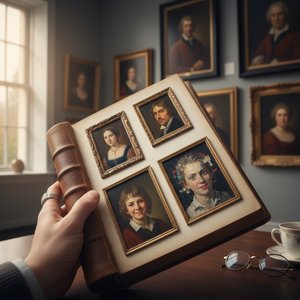
A Life Captured in Light and Line
Eduard Putra lived a life that ended far too soon, leaving behind a quiet but deeply felt collection of works that speak to the intimacy of everyday moments. Born in 1883, this Slovak artist possessed a keen eye for the subtle shifts in human expression and the stillness of a room. His years were marked by a dedication to capturing the essence of his subjects, whether through the heavy texture of oil on canvas or the delicate precision of a pencil sketch.
His presence in the art world was defined by a focus on the figurative. He found meaning in the way light fell across a face or how a person sat by a window. There is a sense of quiet observation in his work, as if he were a silent guest in the rooms he painted. His output includes a variety of subjects that reflect a deep interest in the human form and the natural world.
The Art of Observation
The works of Eduard Putra often center on the quietude of domestic life. He had a particular talent for portraiture, focusing on the nuances of a gaze or the posture of a sitter. Many of his paintings and drawings explore themes of solitude and simple tasks, such as sewing or reading. These pieces do not demand attention through grand gestures but instead invite a closer look at the details of existence.
His technical range allowed him to move between different mediums with ease:
- Oil paintings on canvas and board that capture weight and form.
- Detailed drawings that study the anatomy of heads, profiles, and limbs.
- Landscape works that ground his figurative studies in a sense of place.
In pieces like Head Study of a Young Man or Woman by a Window, one can see his commitment to the study of light. He used oil to create depth, often working on smaller scales that feel personal and direct. His drawings, particularly those from the years leading up to 1915, show a rigorous approach to studying movement and structure, from the way a man walks to the way a woman rests.
A Lasting Presence
Though his life ended in 1915, the traces of his vision remain held within important collections. His work is preserved in institutions such as the Slovak National Gallery, where his portraits and studies continue to be studied for their honest depiction of life. The existence of his sketches and paintings in various galleries ensures that his specific way of seeing the world is not lost to time.
The significance of his work lies in its sincerity. He did not seek to reinvent the world, but rather to document it with a gentle, steady hand. Through his portraits and studies, he left behind a record of faces and figures that carry the quiet dignity of their era.
Q&A
키워드로 Eduard Putra의 작품을 찾아볼 수 있나요?
Eduard Putra의 작품은 아티스트의 키워드별 탐색 페이지에서 키워드별로 찾아보실 수 있습니다. 각 키워드를 통해 관련 작품들을 모아 감상하실 수 있습니다.
Eduard Putra은(는) 어느 시대의 작품을 남겼나요?
Eduard Putra은(는) Modern 시대에 활동했습니다. 이 시기는 역사적 맥락 속에서 작가의 예술적 위치를 보여줍니다.
Eduard Putra 작품의 연도별 타임라인이 있나요?
Eduard Putra의 작품을 연도별로 정리하여 보여주는 작품 연대기 페이지입니다.
Eduard Putra의 작품을 분위기별로 찾아볼 수 있나요?
Eduard Putra의 작품은 각 작품이 지닌 분위기에 따라 분류된 무드 룸 페이지에서 무드별로 감상하실 수 있습니다.