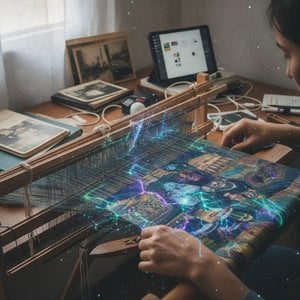
The Legacy of Kalamkari: The Life and Art of Dr. Jonnalagadda Niranjan
Dr. Jonnalagadda Niranjan, born in 1967 in the ancient temple town of Srikalahasti, Andhra Pradesh, India, is not merely an artist; he is a custodian of a centuries-old tradition – Kalamkari. His life story is inextricably woven with the vibrant threads and intricate patterns of this unique textile art form, passed down through generations of his family. Srikalahasti itself breathes Kalamkari, its very air imbued with the scent of natural dyes and the rhythmic strokes of the qalam, the bamboo pen that brings these stories to life. Niranjan’s lineage is steeped in artistic heritage; his great-grandfather and grandfather were both teachers who skillfully balanced their profession with the preservation of this delicate craft, ensuring its survival through challenging times. His father, Padma Shri Guruappa Chetty, was a pivotal figure in revitalizing Srikalahasti Kalamkari, dedicating himself to training aspiring artists and safeguarding the art’s authenticity.
A Family Tradition: From Observation to Mastery
Unlike many who formally pursue artistic education, Niranjan's journey began with immersive observation. As a child, he absorbed the nuances of Kalamkari within his home, learning directly from his father. This early exposure wasn’t merely about technique; it was about understanding the soul of the art form – its connection to mythology, spirituality, and the natural world. He initially pursued a degree in English, but his passion for Kalamkari proved irresistible. He found himself drawn back to the rhythmic precision of hand-painting, recognizing that this craft wasn’t just a skill, but an intrinsic part of his identity. This dedication led him to become one of India's most celebrated masters of Kalamkari, carrying forward a legacy built on generations of expertise.
The Art of Storytelling: Technique and Symbolism
Kalamkari, meaning “pen work,” is far more than decorative painting; it’s a visual narrative. Niranjan's work exemplifies the traditional Srikalahasti style, characterized by its intricate depictions of Hindu epics like the Ramayana and Mahabharata, as well as scenes from local folklore. The process itself is remarkably complex. Cotton fabrics are meticulously prepared through numerous washes and treatments before being outlined with a natural mordant derived from alum. The artists then employ the qalam – crafted from bamboo or date palm sticks – dipped in vibrant dyes extracted from plants, minerals, and even shells. Each color requires multiple applications, building layers of depth and richness. Niranjan’s mastery extends beyond technical skill; he seamlessly blends contemporary designs with these age-old techniques, ensuring the art form remains relevant while honoring its roots.
Influences Beyond Tradition: Dance, Temples, and Scriptures
Niranjan's commitment to authenticity isn’t limited to technique. He actively sought ways to deepen his understanding of the stories he depicted. Recognizing the importance of accurate representation, he studied classical Indian dance to capture the correct postures and movements in his figures. He also embarked on journeys to numerous temples across India, meticulously photographing carvings and architectural details – a quest for unique and often overlooked themes that could be incorporated into his work. Crucially, Niranjan understood that Kalamkari is deeply rooted in mythology; he immersed himself in scriptures and narratives, ensuring the accuracy and depth of his storytelling. This holistic approach—combining artistic skill with scholarly knowledge—sets his work apart.
Recognition and Preservation: A Padma Shri Recipient
Dr. Jonnalagadda Niranjan’s contributions to Kalamkari have been widely recognized. In 2008, he was awarded the Padma Shri, India's fourth highest civilian honor, a testament to his dedication and artistry. He founded the art studio, Kalamkari, in Srikalahasti, which serves as both a creative space and a center for training future generations of artists. He has conducted workshops on natural dyes and Kalamkari painting across India and internationally – Zurich, Switzerland; Taiwan; Sri Lanka; and New York—sharing his knowledge and passion with the world. His involvement in projects like the ICEF (India Canada Environment Facility) Project and collaborations with institutions such as the PARK HOTEL in Hyderabad demonstrate his commitment to preserving this art form while exploring new avenues for its expression. Niranjan’s work is not simply about creating beautiful textiles; it's about safeguarding a cultural heritage, ensuring that the stories of Kalamkari continue to be told for generations to come.
질의응답
Dr. Jonnalagadda Niranjan의 다른 이름이나 별칭에는 무엇이 있나요?
Dr. Jonnalagadda Niranjan은(는) Niranjan Jonnalagadda(으)로도 알려져 있습니다.
Dr. Jonnalagadda Niranjan 작가의 작품을 감상할 수 있는 가상 박물관에 방문할 수 있나요?
Dr. Jonnalagadda Niranjan의 작품은 작가의 3D 뮤지엄 페이지에 마련된 3D 갤러리에서 감상하실 수 있습니다.
Dr. Jonnalagadda Niranjan의 작품을 분위기별로 모아둔 곳은 어디인가요?
아티스트의 무드 룸 페이지에서는 Dr. Jonnalagadda Niranjan의 작품들을 분위기에 따라 큐레이션된 형태로 만나보실 수 있습니다.