The Scholar-Official of the Brush and Pen
In the golden era of the Qing dynasty, few figures embodied the harmonious union of political authority and artistic refinement as gracefully as Dong Bangda. Born in 1699 in Fuyang, Zhejiang Province, Dong was far more than a mere painter; he was a quintessential literati scholar-official whose life unfolded within the highest echelature of the imperial court. Known by his courtesy name Fucun and his sobriquet Dongshan, he navigated the complex corridors of power with the same precision he applied to his calligraphy. His ascent through the imperial bureaucracy was nothing short of meteoric, eventually leading him to the prestigious position of President of the Ministry of Rites. This dual existence—balancing the heavy responsibilities of statecraft with the delicate nuances of ink and wash—allowed him to infuse his art with a profound sense of dignity and intellectual depth.
Dong’s life was deeply intertwined with the imperial family, a connection that elevated his artistic standing to unprecedented heights. His works were not merely admired but were actively cherished by the Qianlong and Jubing Emperors, who frequently graced his paintings with their own colophons. Such royal patronage transformed his landscapes into much more than visual compositions; they became historical artifacts of imperial taste. As a master of the literati style, Dong was part of an elite circle of intellectuals who viewed painting as an extension of one's moral and scholarly character. His ability to capture the essence of the natural world while maintaining the rigorous standards of classical tradition made him a cornerstone of the mid-Qing artistic landscape.
Mastery of Landscape and Calligraphic Grace
The artistry of Dong Bangda is characterized by a breathtaking mastery of ink and wash techniques, particularly in his depictions of the natural world. His landscapes are celebrated for their evocative power, utilizing delicate brushstrokes and subtle shading to breathe life into mountains, ancient trees, and flowing waters. He was a practitioner of the literati tradition, which eschewed mere imitation of nature in favor of capturing its spiritual resonance. In his hands, a simple bamboo grove or a misty mountain peak became a meditation on permanence and change. His compositions often reflected the influence of great masters from the Yuan dynasty, yet they possessed a unique spontaneity and freshness that were entirely his own.
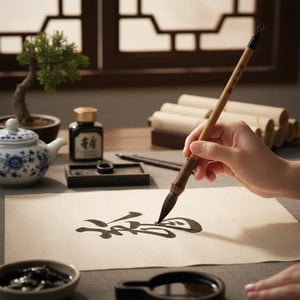
Beyond the realm of landscape painting, Dong was a formidable calligrapher, excelling in the ancient and formal scripts of zhuanshu (seal script) and lishu (clerical script). This mastery of the written word was inseparable from his visual art; for a scholar like Dong, the movement of the brush in calligraphy and the rendering of a mountain ridge were part of the same rhythmic, spiritual pursuit. His calligraphic works possess a structural strength and an elegant fluidity that mirror the balance found in his paintings. This seamless integration of text and image is perhaps best seen in his handscrolls, where inscriptions and landscapes dance together in a unified aesthetic experience.
Legacy of the Three Dongs
The historical significance of Dong Bangda extends far beyond his personal achievements as an official and artist. He is historically revered as one of The Three Dongs, a distinction that places him alongside the legendary masters Dong Yuan and Dong Qichang. This lineage connects him to the very heart of Chinese landscape tradition, marking him as a vital link in the continuity of classical aesthetics. His contributions to the imperial collection catalogues, such as the Shiqu baoji, further cement his role as a guardian of cultural heritage, ensuring that the artistic treasures of the era were documented and preserved for posterity.
Though he passed away in 1769, leaving behind a legacy of profound beauty and scholarly rigor, Dong Bangda’s influence continues to resonate. His work remains a testament to a period when art, politics, and philosophy were inextricably linked. To look upon a Dong Bangda landscape is to witness the quiet strength of a man who found the infinite within the finite, and the eternal within the stroke of a brush. His life stands as a monument to the ideal of the scholar-artist: a soul capable of governing an empire while remaining deeply attuned to the whispers of the wind through the pines.
Q&A
Dong Bangda 작가의 국적은 어디인가요?
Dong Bangda은(는) Qing dynasty 출신입니다.
Dong Bangda 작가의 작품을 감상할 수 있는 3D 갤러리는 어디인가요?
Dong Bangda의 작품은 작가의 3D 갤러리 페이지 내 3D 갤러리에서 감상하실 수 있습니다.
Dong Bangda의 작품을 컬러 팔레트별로 둘러볼 수 있나요?
컬러 팔레트별로 보기 페이지에서는 Dong Bangda의 작품들을 색상 팔레트별로 모아볼 수 있습니다.
Dong Bangda의 작품들은 어떤 분위기를 담고 있나요?
Dong Bangda의 작품은 각 작품이 지닌 분위기에 따라 분류된 무드 룸 페이지에서 무드별로 감상하실 수 있습니다.