The Shadows of Montparnasse
A small woodworking studio in Ciudad Rodrigo holds the earliest traces of Celso Lagar Arroyo. Born in 1891, he begins his training under the watchful eye of his father, a religious sculptor. The transition from wood to clay and stone follows a path through Madrid, where the workshop of Miguel Blay provides a rigorous foundation. By 1910, the focus shifts toward Barcelona and the Escola de la Llotja, but the pull of Paris remains the true north.
Paris in 1911 is a collision of new forms. On a scholarship, Lagar enters a world where sculpture begins to yield to the flat plane of the canvas. He meets Joseph Bernard and Amedeo Modigliani, figures who define the atmosphere of his burgeoning career. It is here that he encounters Hortense Begué, a French sculptor who becomes his wife and creative companion. The studio life in Paris is one of intense contact with the avant-garde, moving through circles that include Jean Metzinger and the art dealers Guillaume and Zborowski.
The Circus and the Plainist Vision
The 1920s bring a specific, heavy focus to his work. He finds a profound metaphor in the circus world—the clowns, the acrobats, and the itinerant life of the performers. These subjects allow him to explore themes of loneliness and the human condition through a lens of tragedy and comedy. He coins the term Plainism to describe his approach during this period, a style shaped by the structural influences of Cubism, Fauvism, and Orphism.
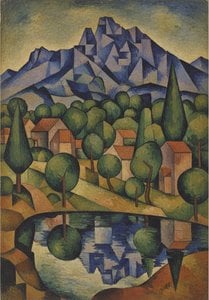
His palette and subject matter expand across borders. While the circus provides a central motif, he also captures the landscapes of Normandy and the tension of bullfighting. The influence of Goya and Picasso is visible in his handling of form and light. His work moves through various technical phases:
- Cubism and Fauvism influences during his early Parisian years.
- The exploration of circus motifs and the tragicomic sense of the performer.
- The development of Plainism as a personal stylistic identifier.
- Later engagements with landscapes and Spanish-inspired subjects.
A Final Return to Spain
War changes everything. During the Second World War, Lagar and Begué seek refuge in the French Pyrenees, facing severe financial hardship and difficult living conditions. The stability of his Parisian life dissolves. After the death of Hortense in 1956, the creative impulse begins to fade. He enters a period of deep depression and is eventually admitted to the Sainte Anne asylum in Paris.
The end of the story finds him far from the cafes of Montparnasse. In October 1964, he returns to Spain, settling in Seville. He lives his final months with his sister, far from the vibrant, experimental streets where he once stood alongside the giants of the School of Paris. He dies in Seville on September 6, 1966.