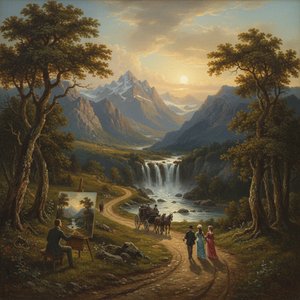
The Quiet Observer of the Austrian Landscape
In the heart of the Austrian Empire, a painter emerged from the town of Rešov to capture the shifting character of a changing era. Carl Thöndel lived through a period of profound transformation, watching as the traditional contours of the countryside began to merge with the rising structures of industry. His life, spanning from the early nineteenth century into the dawn of the twentieth, was defined by this steady observation of the land and the marks left upon it by human endeavor.
He moved through the world with the eye of a man attuned to the subtle shifts in light and atmosphere. His work did not seek to shout, but rather to record the quiet reality of the terrain. Through his brush, the landscape became a living entity, shaped by both the natural elements and the growing presence of man-made industry.
A Vision of Industry and Earth
As the decades progressed, Thöndel turned his attention toward the intersection of nature and progress. He was particularly drawn to the way the landscape absorbed the presence of new developments, a theme that found its most concrete expression in his later years. His technique relied on the careful application of oil on canvas, a medium that allowed him to build depth and texture within his scenes.
His artistic output reflects a specific interest in the changing face of his homeland, specifically within the regions of Lower Austria. The following elements characterize his approach to the canvas:
- The depiction of industrial elements integrated into natural settings.
- A focus on the atmospheric qualities of the Austrian countryside.
- The use of oil to capture the heavy, tangible textures of the earth and industry.
The Legacy of the Rešov Painter
By the time of his passing in 1913, Thöndel had spent many decades documenting a world that was rapidly moving away from the old ways. His paintings, such as his 1890 work Industrial Landscape in Lower Austria, remain as records of a specific moment in time. He captured the tension between the organic curves of the hills and the rigid lines of industrial growth.
He remains a painter of the landscape, a man who understood that the earth is never static. His contribution lies in his ability to hold a mirror to the changing environment, preserving the visual memory of the Austrian landscape as it transitioned into a modern age.
Q&A
Carl Thöndel 작가의 작품을 감상할 수 있는 3D 갤러리는 어디인가요?
Carl Thöndel의 3D 갤러리는 작가의 작품들을 가상 3D 갤러리로 감상할 수 있는 페이지입니다.
Carl Thöndel 작가 작품의 컬러 프로필은 어디에서 확인할 수 있나요?
Carl Thöndel 작가 작품의 컬러 프로필은 작가의 팔레트 지놈 페이지에서 확인하실 수 있습니다.
특정 주제별로 Carl Thöndel의 작품을 어떻게 찾아볼 수 있나요?
Carl Thöndel의 키워드별 탐색 페이지에서는 작가의 작품들을 키워드별로 모아볼 수 있습니다.
Carl Thöndel 작가의 작품 관련 통계 정보는 어디에서 확인할 수 있나요?
Carl Thöndel 작가의 작품 통계 정보는 방문 통계 페이지에서 확인하실 수 있습니다.