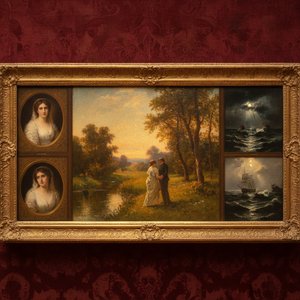
The Quiet Legacy of Carl Langhorst
In the vast tapestry of late nineteenth and early twentieth-century European art, certain names resonate not through loud rebellion, but through a profound, steady mastery of light and atmosphere. Carl Langhorst, born in 1867, belongs to this distinguished lineage of painters who captured the fleeting essence of the natural world with unparalleled sensitivity. His life, spanning from the height of the industrial revolution to the mid-twentieth century, was a journey through an era of immense transition, yet his brush remained anchored in the timeless beauty of the landscape and the subtle nuances of light.
Langhorst’s artistic development was characterized by a deep reverence for the traditions of his era, blended with a keen eye for the atmospheric shifts that define the European countryside. While much of the art world was being swept up in the radical distortions of modernism, Langhorst found his voice in the delicate interplay between shadow and illumination. His work often evokes a sense of nostalgia, inviting the viewer into a serene, almost meditative space where the rustle of leaves or the soft glow of a setting sun feels tangibly present.
Technique and Aesthetic Vision
To observe a Langhorst painting is to witness a masterclass in tonal harmony. He possessed an extraordinary ability to manipulate color temperatures, using subtle shifts in hue to suggest depth and moisture in the air. His technique was never merely about the depiction of objects, but rather about the capture of the spirit of a place. Through careful layering and a sophisticated understanding of light, he could transform a simple pastoral scene into a dramatic narrative of time passing.
The hallmarks of his aesthetic approach include:
- Atmospheric Perspective: The use of soft edges and receding tones to create an immersive sense of three-dimensional space.
- Luminosity: A focused dedication to capturing how light interacts with different textures, from the velvet of moss to the shimmer of water.
- Harmonious Palette: A preference for naturalistic color schemes that evoke a sense of organic unity and peace.
Historical Significance and Enduring Appeal
Though his career unfolded during a period of intense artistic upheaval, Langhorst’s contribution to the landscape tradition remains significant. He provided a bridge between the classical academic traditions and a more emotive, impressionistic sensibility. His works serve as vital historical documents, preserving the quiet, unhurried beauty of a world that was rapidly changing around him.
Today, the legacy of Carl Langhorst lives on through the enduring emotional resonance of his canvases. Collectors and art enthusiasts are drawn to his ability to evoke tranquility in an increasingly chaotic world. His paintings do not demand attention through shock or dissonance; instead, they earn it through a persistent, quiet beauty that continues to captivate the heart, reminding us of the profound grace found in the simplest corners of the earth.
Q&A
Carl Langhorst의 출생 도시와 국가는 어디인가요?
Carl Langhorst은(는) Germany Rahden에서 태어났습니다.
Carl Langhorst의 작품은 얼마나 인기가 있나요?
이 사이트에서 Carl Langhorst의 작품에 관한 통계를 확인할 수 있는 방문 통계 페이지를 만나보세요.
Carl Langhorst 작가는 어떤 사조의 작품 활동을 했나요?
Carl Langhorst의 작품은 작가의 모든 미술 사조 페이지에서 사조별로 만나보실 수 있습니다.
Carl Langhorst의 예술 세계는 시간이 흐름에 따라 어떻게 진화했나요?
Carl Langhorst의 예술적 여정은 연대기 페이지에서 시기별로 펼쳐집니다. 이곳에서는 작가의 활동 시기를 장(chapter)으로 나누어 작품들을 연대순 타임라인 형태로 한눈에 확인할 수 있습니다.