A Life Forged in Hardship and Precision
The trajectory of Carl Johan Brummer begins not in a studio, but in the industrial grit of a Norrköping clothing factory. Following the death of his mother, the young boy from Nyköping is pulled from his schooling to labor for five years. This period of manual toil precedes a sudden shift toward academia in Lund, where he earns his student examination in 1840. The transition from factory worker to art student marks the definitive pivot in his life.
He moves to Copenhagen, entering the Royal Danish Academy of Fine Arts. Between 1840 and 1847, his hands learn the delicate discipline of miniature painting. He masters the art of working on ivory, a medium that demands absolute control and a steady gaze. By the time he settles in Stockholm in 1847, he has become a sought-after portraitist for the Copenhagen social circles, capturing faces on tiny, precious surfaces.
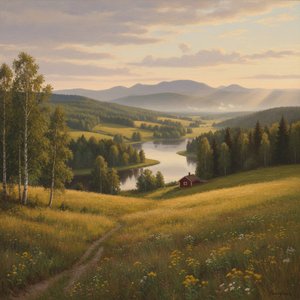
The Miniature and the Landscape
Brummer’s output is defined by a staggering volume of work, specifically in the realm of portrait miniatures. He produces between 300 and 400 of these small-scale works, often utilizing watercolor on ivory or paper. While his miniatures secured his place in society, his curiosity pulled him toward the Swedish countryside. He sought out the light and character of specific regions to fuel his genre scenes and landscapes:
- Dalarna
- Gästrikland
- Skåne
These excursions allowed him to move beyond the controlled environment of the portrait studio and into the open air of the Swedish landscape.
A Quiet Departure
The later years of Brummer’s life are marked by a retreat from the public eye. He lives a secluded existence in Stockholm, often characterized by poverty and a perceived social oddity. He is described by his contemporaries as a man who avoids the crowd, a recluse who eventually relies on a small pension from an aristocratic fund starting in 1867. His presence in the art world becomes a shadow of his former productivity.
Even in this period of isolation, his hand remains active. His studies and sketches are left behind, eventually finding their way to exhibition in Stockholm in 1871. His legacy survives through specific collections, including the Nationalmuseum’s engraving and drawing collection, Malmö Museum, and Gripsholm.
Q&A
Carl Johan Brummer의 출생 도시와 국가는 어디인가요?
Carl Johan Brummer은(는) Sweden Nyköping에서 태어났습니다.
주제별로 분류된 Carl Johan Brummer의 작품들은 어디에서 확인할 수 있나요?
Carl Johan Brummer의 작품은 작가의 주제별 작품 모음 페이지에서 주제별로 찾아보실 수 있습니다.
Carl Johan Brummer 작가의 작품을 감상할 수 있는 3D 갤러리는 어디인가요?
가상 방문이 가능합니다: Carl Johan Brummer의 3D 갤러리 페이지에서 3D 갤러리를 통해 작가의 작품들을 만나보실 수 있습니다.
Carl Johan Brummer의 예술 세계는 시간이 흐름에 따라 어떻게 진화했나요?
Carl Johan Brummer의 예술적 여정은 연대기 페이지에서 시기별로 펼쳐집니다. 이곳에서는 작가의 활동 시기를 장(chapter)으로 나누어 작품들을 연대순 타임라인 형태로 한눈에 확인할 수 있습니다.