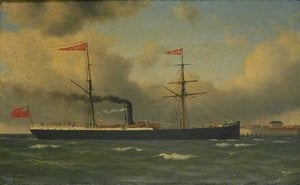
The Soul of the Nordic Sea: The Life and Art of Carl Emil Baagøe
To gaze upon a seascape by Carl Emil Baagøe is to enter a realm of profound stillness, where the boundary between the sky and the salt spray dissolves into a singular moment of quietude. Born in Copenhagen in 1829 to a family deeply rooted in maritime tradition, Baagøe was destined to become one of Denmark’s most evocative marine painters. His father, a sailing master, provided him with an intimate, early education in the rhythms of the ocean—a foundation that would later allow him to translate the complex language of waves and wind onto canvas with unparalleled authenticity. While his formal training at the Royal Danish Academy of Fine Arts equipped him with the technical precision required for classical realism, it was his lived experience among the dockyards and salt-crusted vessels that truly defined his artistic spirit.
Baagøe’s journey toward mastery was marked by a period of romanticized struggle. In his youth, while working as a journeyman decorative painter, he famously chose to embrace a life of near-poverty, frequenting the bustling dockyards not for wages, but for inspiration. He sought the raw, unvarnished reality of seafaring life, observing the grit and grace of fishermen and the heavy, rhythmic labor of the maritime industry. This period of immersion allowed him to move beyond mere imitation; he began to understand the weight of a ship’s hull in the water and the specific, translucent quality of light as it hits a calm Nordic bay. By 1855, having refined his craft through both academic rigor and street-level observation, he began exhibiting the seascapes that would eventually earn him international acclaim.
Voyages of Light and Atmosphere
The true expansion of Baagøe’s visual vocabulary occurred during his extensive expeditions across the North. His travels to Iceland in 1855 and subsequent voyages to the rugged coasts of Norway in the 1860s acted as profound catalysts for his development. These landscapes, characterized by dramatic coastlines and an ethereal, often melancholic light, provided him with a limitless palette of textures and tones. In these works, one can witness his remarkable ability to render the subtle gradations of a twilight sky or the glistening, wet surfaces of weathered rocks. Unlike many of his contemporaries who sought to capture the violent, heroic drama of shipwreks or naval battles, Baagøe found his greatest strength in the tranquil and the sublime.
His technique was a masterclass in atmospheric realism. He favored a palette of muted, sophisticated tones—deep greens, slate grays, and soft cerulean blues—which served to emphasize the mood rather than the spectacle. Through meticulous brushwork, he could convey the heavy movement of a steamship like the SS Sultan or the delicate, intricate rigging of a sailing vessel such as the SS Lion. There is a palpable sense of weight and moisture in his paintings; one can almost feel the dampness of the Norwegian mist or the rhythmic pulse of a tide receding from a pebbled shore. This sensitivity to light allowed him to transform simple maritime scenes into profound meditations on nature’s enduring peace.
A Lasting Maritime Legacy
The historical significance of Carl Emil Baagøe lies in his ability to elevate marine painting from mere documentation to high art. While his works were immensely popular in England, where collectors admired his technical prowess and atmospheric depth, his true legacy is found in the emotional resonance of his compositions. He captured a vanishing era of maritime life—a time when the relationship between man and sea was defined by a quiet, respectful coexistence rather than industrial conquest.
Even as the world moved toward more modern, fragmented styles of art, Baagøe remained a steadfast guardian of the classical marine tradition. His contributions to the Illustreret Tidende and his presence in major collections like the Hull Maritime Museum ensure that his vision of the Nordic coast remains accessible to future generations. To study his work is to revisit a period of maritime history through a lens of serenity, finding beauty in the stillness of the water and the enduring majesty of the sea.
Q&A
Carl Baagøe의 작품 중 조회수가 가장 높은 것은 무엇인가요?
Carl Baagøe의 방문 통계 페이지에서는 이 사이트에 등록된 작가의 작품들을 바탕으로 산출된 통계 정보를 제공합니다.
Carl Baagøe은(는) 어느 시대의 작품을 남겼나요?
Carl Baagøe은(는) 19th Century 시대에 활동했습니다. 이 시기는 역사적 맥락 속에서 작가의 예술적 위치를 보여줍니다.
Carl Baagøe 작가의 작품을 감상할 수 있는 3D 가상 투어가 있나요?
Carl Baagøe의 3D 갤러리는 작가의 작품들을 가상 3D 갤러리로 감상할 수 있는 페이지입니다.
Carl Baagøe 작가의 작품을 연도별로 어떻게 확인할 수 있나요?
Carl Baagøe의 작품 연표를 확인해 보세요: 작품 연대기 페이지에서 작품들을 제작 날짜순으로 보실 수 있습니다.