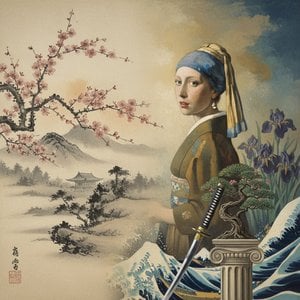
A Quiet Master of Ink: Exploring the Artistry of Bunga Zoho
Bunga Zoho (1779-1840) stands as a singular figure in Japanese art history, primarily recognized for his masterful ink drawings—particularly his evocative depiction of Bodhidharma, the founder of Zen Buddhism. Though biographical details remain scarce, scholarly analysis suggests he honed his skills within the Hakuin School of Zen Buddhism, a tradition deeply rooted in simplicity and contemplation – principles that profoundly shaped his artistic vision.- Early Life & Training: Precise information regarding Zoho’s birthdate and familial background is elusive. However, records indicate he was born in Tokyo during the Edo Period (1603-1868), a time of significant cultural flourishing yet also characterized by strict social hierarchies. His artistic education likely commenced under the tutelage of influential Zen masters—a formative experience that instilled within him an unwavering dedication to capturing spiritual essence through restrained brushwork.
- The Hakuin School’s Influence: Zoho's oeuvre is undeniably indebted to the tenets of the Hakuin School. This school championed a minimalist aesthetic, prioritizing naturalism and conveying profound emotion with minimal ornamentation. Artists like Zoho sought to emulate the serene landscapes and meditative imagery favored by Zen practitioners—a deliberate rejection of elaborate embellishments in favor of capturing the sublime beauty of nature.
- Notable Works: Zoho’s most celebrated piece is undoubtedly his ink drawing of Bodhidharma, a monumental figure revered as the patriarch of Zen Buddhism. The artwork exemplifies Hakuin's stylistic approach—characterized by loose brushstrokes, subtle tonal variations, and an unwavering focus on conveying inner stillness. Its composition skillfully utilizes negative space to emphasize Bodhidharma’s solitary presence against a backdrop of misty mountains—a visual metaphor for enlightenment itself.
- Technique & Style: Zoho's technique involved meticulous observation of nature combined with profound understanding of Zen philosophy. He employed *sumi-e*, the art of monochrome ink painting, prioritizing tonal gradation and capturing atmospheric perspective. The artist’s brushwork was remarkably fluid and expressive—reflecting his inner contemplation and conveying a sense of timelessness.
- Legacy & Recognition: Zoho's artwork continues to inspire admiration within the art world. His meticulous attention to detail and masterful execution demonstrate the enduring power of Zen aesthetics. Although relatively unknown during his lifetime, Zoho’s work has gained recognition in recent years—featured prominently on platforms like MutualArt and Artnet—solidifying his place as a pivotal contributor to Japanese artistic heritage.
Bodhidharma: A Symbol of Enlightenment Embodied
Zoho's depiction of Bodhidharma transcends mere representation; it embodies the core principles of Zen Buddhism. The artist skillfully captures the patriarch’s iconic posture—seated in lotus position atop a mountain—creating an image that speaks to themes of solitude, contemplation and transcendence. Zoho’s use of misty mountains serves as a powerful visual cue—representing the boundless expanse of consciousness and mirroring Bodhidharma's unwavering focus on inner illumination.Exploring Zen Aesthetics: Minimalism & Atmospheric Perspective
Zoho’s artistic approach aligns seamlessly with Hakuin School’s aesthetic ideals. The artist eschews superfluous ornamentation—embracing instead the beauty of simplicity and conveying profound emotion through subtle tonal variations. His masterful manipulation of atmospheric perspective—achieved through delicate brushstrokes—creates a sense of depth and tranquility—reflecting Zen's emphasis on perceiving reality as it truly is—free from illusion.Zoho’s Contribution to Japanese Art History
Despite the paucity of biographical information, Zoho’s artistic legacy remains significant. His unwavering commitment to capturing spiritual essence through minimalist brushwork and atmospheric perspective exemplifies Hakuin School's enduring influence on Japanese art—a tradition that continues to resonate with artists and scholars alike. Zoho’s work stands as a testament to the transformative power of Zen philosophy—demonstrating how artistic expression can illuminate profound truths about human experience.Q&A
주제별로 Bunga Zoho의 작품을 찾아볼 수 있나요?
주제별 작품 모음 페이지에서는 Bunga Zoho의 작품들을 주제별로 확인하실 수 있습니다.
Bunga Zoho의 작품을 컬러 팔레트별로 둘러볼 수 있나요?
컬러 팔레트별로 보기 페이지에서는 Bunga Zoho의 작품들을 색상 팔레트별로 모아볼 수 있습니다.
Bunga Zoho의 작품을 색상별로 찾아볼 수 있나요?
컬러 인덱스 페이지에서는 Bunga Zoho의 작품들을 색상별로 모아 보실 수 있습니다.
Bunga Zoho의 작품은 얼마나 인기가 있나요?
Bunga Zoho의 방문 통계 페이지에서는 이 사이트에 등록된 작가의 작품들을 바탕으로 산출된 통계 정보를 제공합니다.