The Delicate Lineage of Boyun Xiangbai
In the vibrant tapestry of the Qing Dynasty, few artists captured the ephemeral grace of life with as much precision and poetic sensitivity as Boyun Xiangbai. Born around 1774 in the western reaches of China, his origins were rooted in the Hui Muslim families of Xinjiang. This unique cultural heritage provided a foundational layer to his artistic soul, infusing his work with an appreciation for Buddhist aesthetics and a profound sense of harmony that would later define his mastery of the brush. As he moved toward the bustling intellectual hubs of Shanghai, Xiangbai emerged not merely as a painter, but as a vital participant in the era's most sophisticated literary and artistic circles.
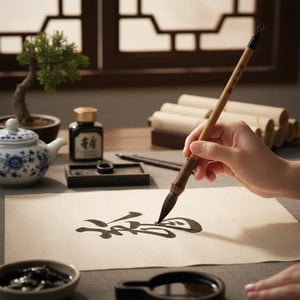
The essence of Xiangbai’s artistry lies in the baimiao technique, a method of outline painting that eschews heavy color in favor of meticulous, rhythmic lines. This approach requires an extraordinary level of discipline, as every stroke must convey weight, texture, and emotion through form alone. Through this restrained framework, he achieved a breathtaking clarity, capturing the subtle trembling of a leaf or the delicate curve of a human silhouette with unparalleled accuracy. His ability to breathe life into static forms allowed him to bridge the gap between the physical world and the spiritual realm, making his landscapes and figure studies feel both intimately present and ethereally distant.
A Masterpiece of Narrative and Legacy
Perhaps the most enduring chapter of Xiangbai’s career is his monumental contribution to the visual legacy of Dream of the Red Chamber. Tasked with illustrating the principal characters of Cao Xueqin's iconic novel, he undertook a journey of profound psychological depth. He did not simply draw faces; he captured the very essence of the characters—such as the renowned poet Zhou Qi—with a sensitivity that mirrored the novel's own complex emotional landscape. These illustrations, often paired with evocative poems by contemporary scholars like Wang Qisun and Cao Zhenxiu, transformed the reading experience into a multi-sensory immersion of sight and verse.
The significance of his work extends far beyond his own lifetime, as his artistic DNA flowed into subsequent generations. His grandson continued the tradition of the gai fei school, a movement that remained deeply anchored in the refined, romanticized aesthetic established by Xiangbai’s illustrations. Today, he is remembered not just as a painter of exquisite detail, but as a cornerstone of a specific Chinese aesthetic—one that celebrates the quiet beauty found in the delicate interplay of line, nature, and human emotion.
Q&A
미술 사조별로 분류된 Boyun; Xiangbai의 작품은 어디에서 볼 수 있나요?
Boyun; Xiangbai 작가의 작품을 예술 사조별로 모아둔 모든 미술 사조 페이지에서 해당 작가가 활동했던 사조를 확인하실 수 있습니다.
Boyun; Xiangbai의 작품들은 어떤 분위기를 담고 있나요?
Boyun; Xiangbai의 작품은 각 작품이 지닌 분위기에 따라 분류된 무드 룸 페이지에서 무드별로 감상하실 수 있습니다.
Boyun; Xiangbai의 모든 작품을 어디에서 볼 수 있나요?
이 사이트에 등록된 Boyun; Xiangbai의 모든 작품은 작가의 전체 작품 보기 페이지에서 만나보실 수 있습니다.