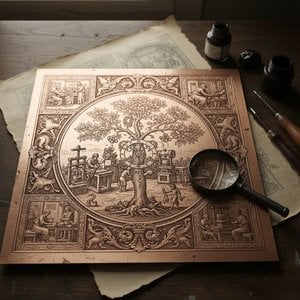
The Visionary of Nuremberg: The Life and Legacy of Augustin Hirschvogel
In the heart of Renaissance Germany, where the intricate craftsmanship of Nuremberg met the burgeoning intellectual curiosity of the age, Augustin Hirschvogel emerged as a polymath whose talents transcended the boundaries of a single discipline. Born in 1503 into a lineage of celebrated artisans, Hirschvogel was destined for a life steeped in the meticulous traditions of his father, Veit Hirschvogel the elder. As a child, he breathed the atmosphere of a workshop dedicated to the luminous art of stained glass, learning how light could be captured and transformed through colored glass. This early immersion in the delicate interplay of transparency and pigment instilled in him a lifelong reverence for detail and an eye for the structural essence of the world around him.
However, the trajectory of Hirschvologel’s life was irrevocably altered by the winds of change sweeping through Europe. The arrival of the Protestant Reformation in Nuremberg brought an abrupt end to the era of lavish, monumental stained-glass commissions. While this period of religious upheaval might have stifled a lesser artist, for Hirschvogel, it served as a catalyst for profound reinvention. He turned his gaze from the ethereal glow of glass toward the tangible precision of mathematics and cartography. This transition from the decorative to the analytical allowed him to merge the aesthetic sensibilities of a painter with the rigorous logic of a scientist, creating a unique artistic voice that was both evocative and mathematically grounded.
Mastery of the Line: The Danube School and Landscape Etchings
Between 1545 and 1549, Hirschvogel achieved his most enduring artistic distinction through a series of thirty-five small landscape etchings. These works placed him at the very center of the Danube School, a movement characterized by its romanticized, often dramatic depictions of the natural world. Unlike the more rigid, classical landscapes emerging elsewhere in Europe, Hirschvogel’s etchings captured the rugged, untamed spirit of the Bavarian and Austrian territories. His mastery of the etching needle allowed him to render the dense foliage of forests, the craggy precipices of the Alps, and the imposing silhouettes of Nuremberg and Hohenzollern Castles with an almost tactile realism.
In these prints, one finds a breathtaking synthesis of observation and emotion. He did not merely document topography; he breathed life into the landscape. Through delicate cross-hatching and varied line weights, he achieved a sense of atmospheric depth that invited the viewer to wander through his miniature worlds. His ability to translate the vastness of the German wilderness onto a small copper plate remains a testament to his technical virtuosity. These etchings were more than mere reproductions of scenery; they were windows into a period where the natural landscape was being rediscovered as a subject of profound spiritual and national identity.
Architect of the Urban Identity: Cartography and City Planning
Beyond the intimate scale of his etchings, Hirschvogel’s intellect reached toward the monumental. His fascination with mathematics and spatial relationships naturally led him into the realm of cartography and urban design. He became a pioneer in the art of city planning, most notably through his contributions to the visual identity of Vienna. His work on intricate maps, such as the Table-Top with Circular Map of the City of Vienna, demonstrated an unparalleled ability to organize complex urban data into beautiful, legible, and aesthetically pleasing compositions.
This period of his career represents the ultimate convergence of his diverse skills. As a cartographer, he possessed the precision required for accurate surveying; as an artist, he understood how to use composition to guide the eye through the labyrinthine streets of a growing metropolis. His visionary approach to urban layout helped shape the very fabric of Vienna’s historical development, leaving a legacy that is etched into the physical stones of the city itself. Hirschvogel’s life remains a remarkable narrative of adaptation and brilliance—a journey from the colorful windows of a Nuremberg workshop to the grand, structural blueprints of one of Europe's greatest imperial capitals.
질의응답
Augustin Hirschvogel의 모든 작품에 나타나는 색채 활용을 살펴볼 수 있을까요?
Augustin Hirschvogel 작가 작품의 컬러 프로필은 작가의 팔레트 지놈 페이지에서 확인하실 수 있습니다.
Augustin Hirschvogel의 작품을 사조별로 둘러볼 수 있나요?
Augustin Hirschvogel 작가가 활동했던 예술 사조는 작품을 사조별로 분류하여 보여주는 작가의 모든 사조 페이지에서 확인하실 수 있습니다.
Augustin Hirschvogel 작가의 작품을 감상할 수 있는 가상 박물관에 방문할 수 있나요?
Augustin Hirschvogel의 3D 뮤지엄는 작가의 작품들을 가상 3D 갤러리로 선보이는 페이지입니다.