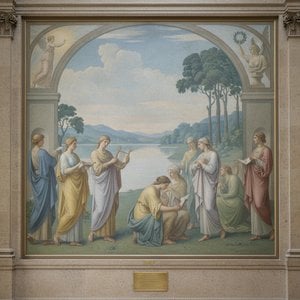
A Life Rooted in the Swiss Landscape
Auguste Baud-Bovy was born in Geneva in 1848, a child of a family deeply connected to the local culture and commerce. His father ran a well-known jewelry store, Le Bijouterie Baud, which remains in business to this day. Much of his early life was shaped by the Château de Gruyères, a summer residence where the Bovy and Balland families lived. This setting provided a meeting place for many notable figures, allowing him to grow up surrounded by an atmosphere of artistic exchange.
His formal training began at the École des Beaux-Arts in Geneva, where he studied under Barthély Menn between 1862 and 1868. In 1868, he married Zoé-Jeanne-Suzanne Bovy, an enamel painter. Following their marriage, he adopted her name to become Baud-Bovy. This period of his life was marked by a growing circle of friends, including those who had arrived in Switzerland following the Paris Commune, such as Gustave Courbet and Joris-Karl Huysmans.
The Search for Light and Solitude
While he spent time teaching drawing at the Municipal Art School in Geneva, Baud-Bovy eventually felt a need to move away from the demands of academic life. In 1880, he left his teaching position and traveled to Spain. This period allowed him to interact with Romani communities and study the works of Goya, which helped brighten his palette. He later moved his family to Paris in 1882, living briefly in the home of a sculptor.
Despite his time in France, the Swiss countryside held a permanent pull on him. After reading about the mountains, he visited Aeschi in the Bernese Oberland and eventually settled there permanently in 1888. His work during these years focused heavily on the natural world, specifically:
- Mountain landscapes
- Village scenes
- Winter scenes
- Depictions of shepherds and nature
Recognition and Final Years
Baud-Bovy achieved significant professional milestones through large-scale projects and international exhibitions. In 1891, he worked alongside Eugène Burnand and François Furet to create a panorama of the Bernese Alps. This work was presented at both the Columbian World Exposition in 1893 and the Chicago World’s Fair that same year. His contributions to the arts were recognized by the French government when he was awarded the Legion of Honor in 1893, a distinction supported by peers like Auguste Rodin and Puvis de Chavannes.
In 1897, he held a major exhibition at the Galerie Durand-Ruel in Paris. However, his health began to decline due to tuberculosis. He sought treatment in Antibes in 1898 before moving to Davos to be with his son, André-Valentin. He died in Davos in 1899, leaving behind a body of work that remains held in collections such as the Musée d'Art et d'Histoire in Geneva and the Kunsthaus Zürich.
Q&A
Auguste Baud-Bovy의 작품을 컬러 팔레트별로 둘러볼 수 있나요?
컬러 팔레트별로 보기 페이지에서는 Auguste Baud-Bovy의 작품들을 색상 팔레트별로 모아볼 수 있습니다.
Auguste Baud-Bovy의 출생 도시와 국가는 어디인가요?
Auguste Baud-Bovy은(는) Switzerland Geneva에서 태어났습니다.
Auguste Baud-Bovy 작가 작품의 컬러 프로필은 어디에서 확인할 수 있나요?
Auguste Baud-Bovy의 팔레트 지놈에서는 작가의 작품 세계를 구성하는 컬러 프로필을 확인하실 수 있습니다.
Auguste Baud-Bovy 작품의 연도별 타임라인이 있나요?
Auguste Baud-Bovy의 작품은 작품 연대기 페이지에서 연도순으로 확인하실 수 있습니다.