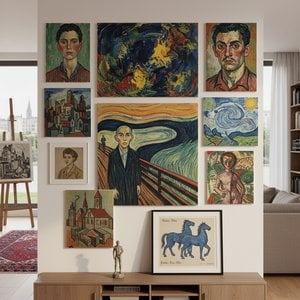
August Heinrich Andreae: A Pioneer of German Lithography
August Heinrich Andreae (4 December 1804, Garbsen, Hannover) was a German lithographer and artist who achieved considerable renown during the Weimar Republic for his evocative depictions of urban landscapes and social life. His work stands as a testament to the burgeoning artistic spirit of the era and cemented his place among Germany’s leading printmakers. Andreae's distinctive style—characterized by meticulous detail, atmospheric perspective, and subtle tonal gradations—influenced generations of artists and continues to resonate with collectors and scholars alike.- Early Life & Education: Born into a family of merchants, Andreae displayed an early aptitude for drawing and engraving. He studied at the Hannover Kunstakademie (Academy of Fine Arts) where he honed his skills in etching and lithography under Johann Christian Gärtner, a prominent figure in German printmaking.
- Career Highlights: Andreae established his own workshop in Hannover shortly after graduating and quickly gained recognition for his artistic talent. He collaborated extensively with writers and poets of the time, producing stunning illustrations for literary publications that captured the essence of Weimar culture. Notably, he worked on projects for Goethe’s Faust II and Wilhelm Meister's Wanderjahre, demonstrating his ability to translate complex narratives into visually compelling images.
- Lithographic Technique & Style: Andreae championed lithography as a medium, recognizing its potential for achieving nuanced tonal effects and reproducing intricate textures. He meticulously prepared stone surfaces, applying acid etching techniques with precision and patience—a hallmark of his artistic process. His prints are distinguished by their atmospheric realism, capturing the subtle nuances of light and shadow to convey mood and emotion.
- Notable Works: Andreae’s oeuvre includes numerous landscapes depicting Hannover and its environs, as well as portraits of prominent figures from Weimar society. Among his most celebrated pieces is “At the Edge of the Forest,” a lithograph that exemplifies his masterful command of tonal gradation and compositional balance—a piece frequently reproduced in art books and exhibitions.
- Legacy & Influence: Andreae’s contribution to German printmaking extended beyond individual artworks; he actively mentored younger artists and fostered a tradition of meticulous craftsmanship. His stylistic innovations influenced subsequent generations of lithographers, shaping the visual language of Weimar art and establishing him as an enduring icon of German artistic heritage.
Exploring Andreae's Artistic Vision: Influences & Inspirations
Andreae’s artistic sensibilities were profoundly shaped by Romanticism—a movement that prioritized emotion, imagination, and the sublime experience of nature. He drew inspiration from Caspar David Friedrich’s landscapes, adopting a similar approach to conveying spiritual contemplation and capturing the grandeur of the natural world. Furthermore, Andreae's meticulous attention to detail mirrored the precision demanded by scientific illustration, reflecting the broader intellectual currents of his time. The influence of Eugène Delacroix’s dramatic compositions—particularly his depictions of historical events—can also be discerned in Andreae’s stylistic choices.The Blasius Collection & Andreae's Artistic Contribution
Andreae’s work found a prominent home within the Blasius Collection, established by Wilhelm Heinrich Blasius (1839-1906), a wealthy Hannover businessman and art collector. The collection showcased Andreae’s lithographs alongside other masterpieces of German Romanticism—demonstrating Blasius's commitment to preserving artistic heritage and fostering appreciation for visual culture. Today, the Blasius Collection continues to inspire scholars and enthusiasts alike, ensuring that Andreae’s legacy endures as a cornerstone of Weimar art history.Q&A
August Heinrich 작가의 작품을 감상할 수 있는 3D 가상 투어가 있나요?
August Heinrich의 3D 갤러리는 작가의 작품들을 가상 3D 갤러리로 감상할 수 있는 페이지입니다.
August Heinrich의 출생지와 출생 연도는 어떻게 되나요?
August Heinrich은(는) 1794년 Dresden에서 태어났습니다.
August Heinrich의 작품을 분위기별로 찾아볼 수 있나요?
August Heinrich의 작품은 각 작품이 지닌 분위기에 따라 분류된 무드 룸 페이지에서 무드별로 감상하실 수 있습니다.