A Life in the Heart of Mexico City
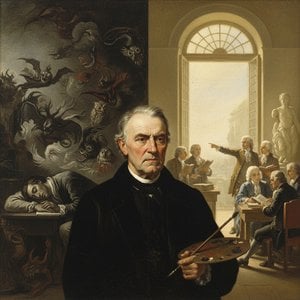
Born in Mexico City around 1636, Antonio Rodríguez lived a life deeply embedded in the social and religious fabric of New Spain. He was the son of Sebastián Rodríguez and Isabel Beltrán, and his domestic life was defined by his marriage to Antonia Juárez in 1659. This union connected him to established lineages, as his wife was the daughter of José Juárez and Isabel de Contreras. His household was a center of activity, producing children such as Nicolás and Juan Rodríguez Juárez, who would carry the family name into the next generation of the city's creative and social circles.
His professional existence was marked by a commitment to the formal structures of his craft. He was not merely a solitary creator but a participant in the organized life of the painters in Mexico City. By 1674, he was among the masters who granted legal power to representatives to defend the interests of painters before both secular and ecclesiastical courts. This involvement suggests a man who understood the necessity of institutional standing and the legal complexities of maintaining a professional practice in the seventeenth century.
Artistic Training and Affiliations
The development of his hand began in the workshop of José Juárez, a setting that provided the technical foundation necessary for a career in the second half of the seventeenth century. His work emerged from a period of significant artistic activity in the region, influenced by the styles and methods shared among his contemporaries. His professional circle included several notable figures of the era, including:
- José López
- Antonio Sarmiento Girón
- José Rodríguez Carnero
His residence on San Francisco street placed him in the center of the urban life of Mexico City. This proximity to the religious and civic hubs of the city likely informed the subjects he chose to depict, as his life was inextricably linked to the institutions that commissioned his work.
Documented Works and Final Years
The surviving record of his output provides a glimpse into the religious devotion that characterized his era. His brush was applied to subjects of profound spiritual weight, such as the Saint Augustine held in the Museo Nacional de Arte, Mexico City. Other documented pieces include Santo Tomás de Villanueva, which he signed and dated in 1668, and Ánimas del Purgatorio, dated 1677, which was located in the former convent of Churubusco. These works reflect a painter engaged with the theological demands of his time.
Antonio Rodríguez died in Mexico City on April 3, 1691. His life concluded in the same city where it had begun, and he was laid to rest in the Church of San Agustín. He left behind a legacy of professional stability and a body of work that remains part of the historical record of New Spanish painting.
Q&A
키워드별로 분류된 Antonio Rodríguez의 작품은 어디에서 볼 수 있나요?
Antonio Rodríguez의 작품은 아티스트의 키워드별 탐색 페이지에서 키워드별로 찾아보실 수 있습니다. 각 키워드를 통해 관련 작품들을 모아 감상하실 수 있습니다.
특정 매체로 분류된 Antonio Rodríguez의 모든 작품을 어떻게 찾을 수 있나요?
모든 매체별 페이지에서는 Antonio Rodríguez의 작품을 기법별로 모아볼 수 있습니다.
주제별로 분류된 Antonio Rodríguez의 작품들은 어디에서 확인할 수 있나요?
주제별 작품 모음 페이지에서는 Antonio Rodríguez의 작품들을 주제별로 확인하실 수 있습니다.
Antonio Rodríguez의 작품을 팔레트별로 모아둔 곳은 어디인가요?
특정 색상 팔레트의 Antonio Rodríguez 작품을 찾으시려면, 작가의 컬러 팔레트별로 보기 페이지를 이용해 보세요.