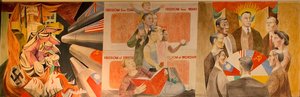
Anton Refregier: A Visionary of Social Realism and San Francisco’s History
Anton Refregier (March 20, 1905 – October 10, 1979) stands as a significant figure in American art history, particularly recognized for his monumental mural series “The History of San Francisco” and his contribution to the Works Progress Administration (WPA). Born in Moscow, Refregier’s journey to artistic prominence began with an emigration to the United States in 1920, marking the start of a prolific career characterized by social realism and a deep engagement with the cultural landscape of his adopted nation.
Early Life and Artistic Training
Refregier's formative years were spent navigating the challenges of adapting to a new environment while honing his artistic skills. After securing a scholarship to Rhode Island School of Design in 1921, he immersed himself in formal training, developing a foundational understanding of classical techniques alongside emerging modernist influences. Returning to New York City in 1925, he pursued freelance commissions, specializing in replicating iconic paintings by masters like François Boucher and Jean-Honoré Fragonard – an endeavor that instilled in him meticulous craftsmanship and an appreciation for artistic heritage. His travels to Munich in 1927 proved pivotal, exposing him to the burgeoning movement of Abstract Expressionism under the mentorship of Hans Hofmann, shaping his stylistic sensibilities and broadening his artistic horizons.
The Influence of Depression Era Inspiration
Refregier’s artistic development gained considerable momentum during the Great Depression era (1935-1939), a period that profoundly impacted his worldview. Living in the Mount Airy Artists' Colony in Croton-on-Hudson, he experienced firsthand the hardships faced by ordinary Americans and drew inspiration from these realities. As Refregier eloquently stated, “The richer we in possessions, the poorer we became in their enjoyment,” reflecting a humanist perspective rooted in empathy and social consciousness—a sentiment that resonated deeply within his artistic vision. He recognized the transformative power of confronting adversity and translating it into compelling visual narratives.
WPA Mural Commissions and Artistic Legacy
The Works Progress Administration (WPA), established in 1935, provided Refregier with an invaluable opportunity to realize his ambitions as a muralist. This government initiative championed artistic endeavors during the Depression, fostering collaboration between artists and communities. Refregier’s involvement in WPA projects culminated in “The History of San Francisco,” a breathtaking twenty-seven panel masterpiece commissioned for the Rincon Center in downtown San Francisco. Completed from 1940 to 1948, this monumental artwork encapsulates the entirety of California's history—from prehistoric times through the early 20th century—employing bold tonal contrasts and expressive brushwork characteristic of social realism. Refregier’s enduring legacy resides not only in his artistic output but also in his unwavering commitment to portraying human experience with dignity and compassion, cementing his place as a champion of American art history.
Further Exploration
For more information about Anton Refregier's life and work, please refer to the following resources: