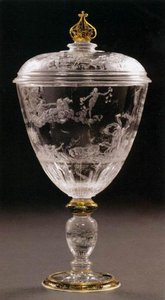
The Silent Maestro of Crystal and Fresco
In the storied annals of the Italian Mannerist period, few names evoke as much quiet reverence as Annibale Fontana. A master whose presence in the historical record is as delicate as the materials he manipulated, Fontana emerged from Milan around 1540 to leave an indelible mark on the realms of sculpture, medal-making, and crystal-work. His life, though relatively brief, was a testament to the profound impact that meticulous craftsmanship and an obsession with light can have on the visual language of the Renaissance. Unlike the grandiloquent masters who sought fame through sprawling theatrical displays, Fontana cultivated a specialized excellence, focusing on the intimate interplay between substance and illumination.
Fontana’s artistic journey began in the vibrant workshops of Milan, where he studied under the sculptor Giovanni Battista Brustellini. This early training was foundational, instilling in him a rigorous commitment to anatomical precision and the classical ideals that defined the era. Under Brustellini’s tutelage, Fontana learned to perceive the potential for narrative within solid forms, a skill that would later allow him to breathe life into bronze and stone alike. His formative years were characterized by this pursuit of technical perfection, preparing him for a career that would bridge the gap between the tactile reality of sculpture and the ethereal beauty of light-refracting gems.
A Mastery of Light and Material
The true breakthrough of Fontana’s career arrived with his extraordinary ability to manipulate crystalline structures. His most celebrated achievement, a breathtaking crystal case commissioned by Albert V, Duke of Bavaria, remains a pinnacle of sixteenth-century craftsmanship. Completed between approximately 1560 and 1570, this work serves as a masterclass in illusionism. By working with translucent materials, Fontana was able to capture and bend light, creating a sense of depth and movement that seemed to defy the physical limitations of the medium. This piece did more than merely showcase his skill; it transformed a precious object into an instrument of artistic expression, proving that even the most rigid materials could be made to dance with luminosity.
This fascination with light extended beyond crystal into his work with bronze and medals. His ability to render complex mythological scenes—such as The Abduction of Dejanira or the struggle of Hercules and Cerberus—within the small, controlled space of a medal or a bronze plaque demonstrates a remarkable command over composition. In these works, Fontana utilized the subtle textures of metal to convey psychological nuance and muscular tension, ensuring that even in miniature, his subjects possessed a monumental presence.
Legacy and the Sculptural Spirit
As his career progressed, Fontana’s influence traveled far beyond the borders of Lombardy. His time in Palermo, serving as a sculptor for Francesco Farnese II, the Viceroy of Naples, allowed him to expand his repertoire into portraiture. Here, he captured the likenesses of the era's most prominent figures with a sensitivity that balanced formal dignity with human emotion. Upon returning to Lombardy, his work continued to shape the sacred spaces of his homeland, notably through his contributions to the church of Santa Maria presso San Celso. His execution of statues for the church’s façade, including the prophetic figures of Isaiah and Jeremiah, showcased a sculptor capable of integrating fine detail into the grand architectural landscape.
- Artistic Versatility: A rare ability to move seamlessly between the delicate precision of crystal-working and the robust demands of bronze sculpture.
- Technical Innovation: Pioneered the use of light-refracting materials to create illusionistic depth in decorative arts.
- Historical Impact: Contributed significantly to the Mannerist movement through his focus on anatomical accuracy and psychological portraiture.
Though he passed away in 1587, leaving behind a body of work that is remarkably sparse yet intensely potent, Annibale Fontana remains a vital figure for understanding the breadth of the late Renaissance. He was an artist who understood that true greatness often resides in the details—in the way a shadow falls across a bronze muscle or how a beam of light pierces through a faceted gem. His legacy is one of quiet brilliance, reminding us that the most enduring art is often that which masters the ephemeral elements of our world.
질의응답
Annibale Fontana가 그린 모든 주제를 한눈에 볼 수 있는 개요가 있나요?
Annibale Fontana의 주제별 아틀라스는 작가의 작품들을 주제별로 분류하여 보여주는 페이지입니다.
Annibale Fontana 작가는 어떤 색상을 가장 자주 사용했나요?
본 웹사이트에 등록된 작품 전반에 나타나는 Annibale Fontana의 색채 활용은 작가의 팔레트 지놈 페이지에서 확인하실 수 있습니다.
키워드별로 분류된 Annibale Fontana의 작품은 어디에서 볼 수 있나요?
특정 주제의 Annibale Fontana 작품을 찾으려면 키워드별로 작품이 분류된 작가의 키워드별로 페이지를 이용해 보세요.