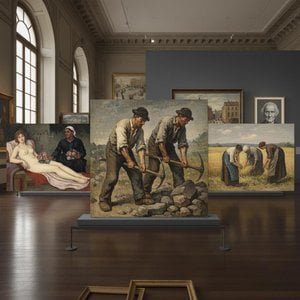
A Life Painted in Light and Tradition
Born amidst the serene landscapes of Mariestad, Sweden, on May 13, 1847, Anna Christina Nordgren emerged from a landowning family whose movements across estates like Åsen and Sjögerås provided a rich, shifting backdrop for her developing eye. Her journey into the world of fine art began not in a grand studio, but in the quiet corners of her childhood, guided by a governess who recognized the burgeoning talent within the young girl. This early spark ignited a formal passion that would lead her from the girls' school in Skara to the prestigious halls of the Slöjdskolan Stockholm and eventually to the Royal Swedish Academy of Fine Arts. As one of the pioneering female students at the Academy, Nordgren navigated an era where the path for women in art was often narrow, yet she moved through it with a singular, determined grace.
The trajectory of her career was profoundly shaped by her pursuit of mastery beyond the Swedish borders. In 1874, following the counsel of her mentor Johan Christoffer Boklund, Nordgren ventured to Paris, the beating heart of the nineteenth-century art world. This period of immersion in French culture and technique proved transformative. Studying at the renowned Académie Julian under masters such as Tony Robert-Fleury, and later refining her portraiture skills under Carolus-Duran, she absorbed the rigorous discipline of the Academic style. While many of her contemporaries were swept up in the fleeting, light-drenched experiments of Impressionism, Nordgren remained steadfastly devoted to a more structured, classical approach, finding beauty in the enduring weight of form and the profound reality of her subjects.
The Soul of the Genre and Portrait
Nordgren’s artistic identity was defined by a remarkable ability to capture the essence of human experience through both portraiture and genre scenes. Her work often functioned as a window into the lives of those around her, rendered with a meticulous realism that commanded respect. In Paris, she came under the subtle influence of Jules Bastien-Lepage, an encounter that likely deepened her commitment to naturalism. This dedication to truth allowed her to depict not only the nobility of her subjects but also the poignant struggles of the vulnerable. During her years in England, she gained significant recognition for her ability to portray the poor and the marginalized with a dignity that transcended mere observation, turning everyday scenes of hardship into profound meditations on the human condition.
Her technical prowess was frequently celebrated on the international stage, marking several milestones in her professional life:
- International Recognition: In 1876, her talent earned her a place at the Centennial Exposition in Philadelphia, showcasing her Swedish roots to an American audience.
- Royal Acclaim: Her standing within the European art hierarchy was solidified when a painting from her Royal Academy exhibition was purchased by King Oscar, a testament to her mastery of the Academic tradition.
- Exhibition Success: Beyond Paris and Stockholm, she left her mark on the British art scene, exhibiting in London, Glasgow, Liverpool, and Birmingham, where she even held solo exhibitions at the Clifford Galleries.
A Lasting Legacy of Realism
As Nordgren’s life progressed, her travels took her through the rugged beauty of Brittany and into the bustling cultural hubs of the United Kingdom. Throughout these transitions, her brush remained focused on the tangible and the emotive. She moved within circles of great artistic intellect, sharing friendships with figures such as the Russian artist Marie Bashkirtseff and the legendary James McNeill Whistler. These connections placed her at the intersection of various European movements, even as she maintained her unique stylistic independence.
Though she passed away in 1916, the historical significance of Anna Nordgren lies in her role as a bridge between the rigid traditions of the past and the burgeoning realism of the modern era. She was an artist who refused to be swayed by passing fads, choosing instead to cultivate a deep, empathetic connection with her subjects through disciplined technique. Her legacy survives in the quiet strength of her portraits and the evocative, soulful realism of her genre paintings, which continue to remind us of the profound beauty found in the most humble of lives.
Q&A
Anna Nordgren의 작품을 색상별로 찾아볼 수 있나요?
컬러 인덱스 페이지에서는 Anna Nordgren의 작품들을 색상별로 모아 보실 수 있습니다.
Anna Nordgren의 작품을 팔레트별로 모아둔 곳은 어디인가요?
Anna Nordgren의 작품은 작가의 컬러 팔레트별로 보기 페이지에서 컬러 팔레트별로 만나보실 수 있습니다.
Anna Nordgren가 그린 모든 주제를 한눈에 볼 수 있는 개요가 있나요?
Anna Nordgren의 주제별 작품 모음는 작가의 작품들을 주제별로 찾아볼 수 있는 페이지입니다.
Anna Nordgren의 작품을 분위기별로 모아둔 곳은 어디인가요?
Anna Nordgren의 작품은 각 작품이 지닌 분위기에 따라 분류된 무드 룸 페이지에서 무드별로 감상하실 수 있습니다.