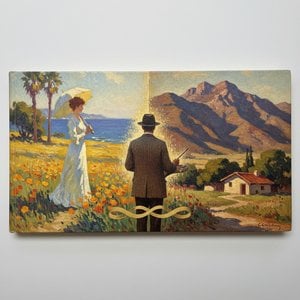
Andrew Putnam Hill: Life, Art, and Conservation
Early Life and Artistic Beginnings
- Born: 1853 in Porter County, Indiana.
- Andrew Putnam Hill began his career as both a painter and a photographer, drawn to capturing the beauty of the American West. His early work focused on realistically depicting landscapes and portraits.
- Influences during this period are not extensively documented but likely included the Hudson River School tradition of landscape painting prevalent at the time.
Artistic Development and Style
- Hill’s artistic style evolved over time, eventually aligning with the Precisionist movement, which gained prominence in the United States after World War I.
- Precisionism emphasized geometric shapes, a reduction of detail, and the use of planes of light to create a sense of crisp focus. Hill’s paintings began to reflect these characteristics, showcasing a meticulous attention to form and clarity.
- While not a strict adherent to all tenets of Precisionism, his work demonstrates a clear affinity for its aesthetic principles.
The Fight for Big Basin Redwood Forest
- Hill is perhaps most celebrated for his pivotal role in preserving the ancient redwood forests of Big Basin, California.
- From 1899 to 1902, he spearheaded a campaign to establish Big Basin as a public park – becoming the first unit within what would eventually become the California State Park System.
- His photographs and paintings of the majestic redwoods played a crucial role in raising awareness about their vulnerability and garnering support for conservation efforts.
- This dedication to preservation marked a turning point in California’s environmental history, establishing a precedent for protecting natural resources.
Notable Works and Collections
- “George W. Hoag” is among his most recognized paintings and resides in the collection of the Crocker Art Museum in Sacramento, California.
- His body of work includes landscapes, portraits, and studies of Californian scenery.
- While not prolific in terms of sheer volume, his paintings are valued for their technical skill and evocative depictions of the natural world.
Legacy and Historical Significance
- Andrew Putnam Hill’s legacy extends beyond his artistic achievements. He is remembered as a pioneer in the conservation movement, demonstrating the power of art to inspire environmental stewardship.
- His efforts laid the groundwork for the extensive network of state and national parks that protect California's natural heritage today.
- Furthermore, his artistic approach influenced subsequent generations of artists working in the fields of Precisionism and Photorealism.
- He died in Pacific Grove, California in 1922, leaving behind a lasting impact on both the art world and the environmental landscape of California.
Q&A
Andrew Putnam Hill 작가의 국적은 어디인가요?
Andrew Putnam Hill은(는) United States of America 출신입니다.
Andrew Putnam Hill의 모든 작품을 어디에서 볼 수 있나요?
이 사이트에 등록된 Andrew Putnam Hill의 모든 작품은 작가의 전체 작품 보기 페이지에서 만나보실 수 있습니다.
키워드로 Andrew Putnam Hill의 작품을 찾아볼 수 있나요?
Andrew Putnam Hill의 작품은 아티스트의 키워드별 탐색 페이지에서 키워드별로 찾아보실 수 있습니다. 각 키워드를 통해 관련 작품들을 모아 감상하실 수 있습니다.