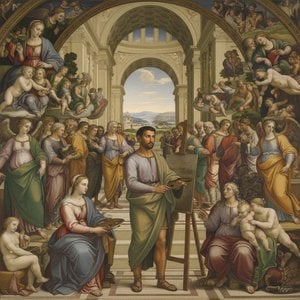
Andrea da Salerno: A Renaissance Echo of Raphael
Andrea da Salerno, also known as Andrea Sabbatini, stands as a compelling figure within the vibrant tapestry of 16th-century Italian art. Born in Salerno, Italy, around 1487 and tragically passing between November 1530 and May 1531, his life was marked by an intense artistic apprenticeship and a profound connection to the legacy of Raphael. While initially trained under Raimondo Epifanio in Naples, it was his relocation to Rome that truly shaped his trajectory, forging a close bond with the master painter himself – a relationship that indelibly influenced his style and output. His work represents a fascinating synthesis of Neapolitan artistic traditions and the burgeoning Mannerist innovations sweeping through the Roman art world.Early Training and the Influence of Naples
Andrea’s early artistic education took place in Salerno, a city steeped in history and renowned for its medical school and rich cultural heritage. While details of his formative years are somewhat sparse, it's understood that he received a solid grounding in traditional Italian painting techniques. His mentor, Raimondo Epifanio, was a respected artist known for his frescoes and panel paintings, providing Andrea with the foundational skills necessary to develop his own unique voice. Naples during this period was experiencing a flourishing of artistic activity, influenced by both Byzantine traditions and emerging Renaissance ideals. This environment undoubtedly contributed to Andrea’s early development, exposing him to diverse styles and techniques.A Disciple of Raphael: Style and Technique
Andrea's most significant artistic connection was undeniably with Raphael. Moving to Rome around 1506, he immersed himself in the master’s studio, absorbing not just his technical prowess but also his philosophical approach to art. Raphael’s influence is immediately apparent in Andrea’s work – a harmonious blend of classical grace, balanced compositions, and an exquisite attention to detail. However, Andrea didn't simply mimic Raphael; he skillfully adapted the master’s style to his own sensibilities, incorporating elements of Neapolitan artistic tradition and developing a distinctive Mannerist flair. His use of color is particularly noteworthy—vibrant yet carefully modulated, creating a sense of luminous depth and atmospheric perspective. He frequently employed intricate details in drapery and ornamentation, hallmarks of the Mannerist movement.Notable Works and Artistic Achievements
Andrea da Salerno’s artistic output comprises a diverse collection of religious paintings and frescoes, many of which are housed in prestigious museums across Italy. Among his most celebrated works are “The Adoration of the Cross,” a dramatic composition brimming with emotional intensity; “The Seven Church Teachers,” an intricate depiction showcasing Andrea's mastery of perspective and detail; and "Madonna with Child," radiating serene beauty. A particularly striking example is “St. Nicholas of Bari on the Bishop’s Throne” (located in the Palazzo Avella di Capodimonte, Naples), which exemplifies his ability to convey both spiritual reverence and regal authority. His frescoes, notably those found in churches like Santa Maria delle Grazie and San Gennaro dei Poveri, demonstrate a remarkable command of fresco technique and a talent for creating visually stunning narratives within sacred spaces. The “Nativity” is often cited as a prime example of his assimilation of Raphael’s style, showcasing the influence of his mentor with subtle yet unmistakable elegance.Legacy and Historical Significance
Andrea da Salerno's legacy extends beyond his individual works; he represents a crucial link between the artistic traditions of Naples and Rome during the High Renaissance. His art reflects the evolving stylistic trends of the period, bridging the gap between the classical ideals championed by Raphael and the increasingly complex and emotionally charged aesthetics of Mannerism. While overshadowed somewhat by his more famous mentor, Andrea’s contributions to Italian painting are significant, particularly in the context of Naples, where he helped shape the artistic landscape of the region. His work continues to be studied and admired for its technical skill, emotional depth, and enduring beauty, serving as a testament to the transformative power of artistic apprenticeship and the lasting impact of a master’s influence. His brief but impactful career underscores the dynamic exchange of ideas that characterized the Renaissance art world.질의응답
Andrea Da Salerno의 작품들은 어떤 분위기를 담고 있나요?
Andrea Da Salerno의 무드 룸는 작가의 작품들을 분위기별로 모아볼 수 있는 페이지입니다.
Andrea Da Salerno의 연도별 활동 기록이 있나요?
Andrea Da Salerno의 예술적 여정은 연대기 페이지에서 시기별로 펼쳐집니다. 이곳에서는 작가의 활동 시기를 장(chapter)으로 나누어 작품들을 연대순 타임라인 형태로 한눈에 확인할 수 있습니다.
Andrea Da Salerno의 작품은 얼마나 인기가 있나요?
Andrea Da Salerno의 작품에 관한 통계를 보여주는 통계 페이지가 본 웹사이트에 마련되어 있습니다.