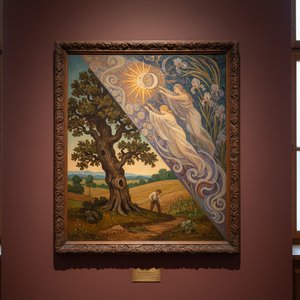
A Life in Art and Education
Alfred Schrötter was an Austrian painter and art educator. Born in Vienna, he pursued his artistic training at the Vienna Academy of Fine Arts, studying under Karl Mayer and August Eisenmenger, and later became a student of Hans Canon. His academic journey continued in Munich, where he studied at the academy under Ludwig von Löfftz. During his time in Munich, he taught costume painting at the Ladies' Academy of the Munich Artists' Association.
Schrötter's career saw him move to Dachau, where he became a representative of the Neu-Dachauer direction. In 1900, he was appointed to lead a master class for painting at the Drawing Academy in Graz, a position he held until 1923. As a teacher, he was highly regarded and helped train a generation of Styrian artists. His artistic output included genre paintings, portraits, landscapes, and frequently, depictions of horses driven by his passion for equestrianism.
Notable Works and Legacy
Throughout his career, Schrötter produced a variety of works that captured diverse subjects. His portfolio includes:
Q&A
Alfred Schrötter의 작품 중 몇 점을 둘러보실 수 있나요?
전체 작품 보기 페이지에서 Alfred Schrötter의 작품 작품 1점점을 만나보실 수 있습니다.
Alfred Schrötter의 작품 전체 목록을 볼 수 있는 곳이 있나요?
이 사이트에 등록된 Alfred Schrötter의 모든 작품은 작가의 전체 작품 보기 페이지에서 만나보실 수 있습니다.
Alfred Schrötter은(는) 어느 시대의 작품을 남겼나요?
Alfred Schrötter은(는) 19th Century 시대에 활동했습니다. 이 시기는 역사적 맥락 속에서 작가의 예술적 위치를 보여줍니다.