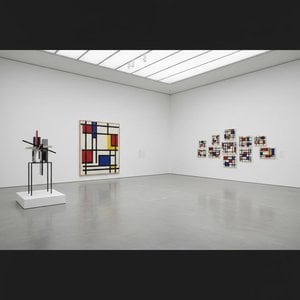
The Architect of Light and Line: The Legacy of Alejandro Otero Lárez
In the vibrant tapestry of twentieth-century Latin American modernism, few threads shine as brightly or as structurally as those woven by Alejandro Otero Lárez. A visionary who redefined the boundaries of the canvas, Otero was not merely a painter but a pioneer of geometric abstraction, a sculptor of space, and a cultural catalyst for Venezuela. Born in the tranquil landscape of El Manteco, Bolívar, on March 7, 1921, his journey from the lush textures of his homeland to the avant-garde studios of Paris represents a profound odyssey of artistic liberation. His early training at the Escuela de Artes Plásticas y Aplicadas Caracas provided him with a rigorous foundation, yet it was his restless intellect that drove him to dismantle the traditional boundaries of representation in favor of a pure, rhythmic language of form.
Otero’s evolution was marked by a series of transformative departures. Following his move to Paris in 1946, the artist underwent a metamorphosis, shedding the luministic landscapes of his youth for a more structured, modernist inquiry. During this period, he engaged deeply with the remnants of Cubism, finding profound expression in still lifes that focused on everyday objects like pitchers and coffeeputts. His series Las cafeteras (The Coffeepots), painted between 1946 and 1948, serves as a vital bridge in his oeuvre; here, the three-dimensional weight of the objects began to dissolve, replaced by an increasingly sophisticated interplay of line and color on a flat plane. This transition was heavily informed by the spiritual and formal echoes of Wassily Kandinsky, whose emphasis on spontaneous gesture and harmonic color resonance provided Otero with a blueprint for conveying deep emotion through non-representational means.
The Rhythm of Abstraction: Coloritmos and Beyond
As Otero’s career matured, he moved beyond the mere arrangement of shapes into the creation of optical energy. The mid-1950s heralded the birth of his most celebrated innovation: the Coloritmos (Colorhythms) series. In these works, Otero achieved a masterful equilibrium between stillness and movement. By placing contrasting dark and light colors in precise vertical bands, he engineered a sense of vibration that seemed to pulse within the two-dimensional plane. This technique did not merely depict color; it orchestrated it, creating an immersive experience where the eye is caught in a perpetual dance of light and shadow. This period also saw his involvement with the Los Disidentes group, a radical collective of Venezuelan artists dedicated to challenging established hierarchies and reimagining the very essence of beauty through a modern, geometric lens.
His exploration of space and materiality extended far beyond the brushstroke. Otero’s mastery of Op Art influences and his work with Tablones demonstrated an architectonic approach to art, where the physical presence of the medium became as significant as the image itself. His ability to engage with every major avant-garde movement of his era—from the structured rigor of geometric abstraction to the experimental textures of informalism—cemented his status as a polymath of the visual arts. Whether through the stark clarity of his monochromes or the kinetic energy of his rhythmic compositions, Otero’s work remained a testament to the power of the fundamental elements: form, color, and composition.
A Lasting Impression on the Modern Canon
The historical significance of Alejandro Otero Lárez cannot be overstated. He was a central figure in establishing Venezuela as a powerhouse of international abstraction, bridging the gap between local identity and global modernism. His accolades, including the National Prize for Painting and prestigious recognitions at the Biennale of São Paulo, reflect a career defined by excellence and innovation. Beyond his personal canvases, his role as a cultural promoter and writer ensured that the movement he helped lead would leave an indelible mark on future generations.
To contemplate the work of Otero is to witness the triumph of the abstract spirit. His legacy remains preserved in the great institutions of the world, such as the Museum of Modern Art (MoMA), where his contributions continue to inspire awe. He leaves behind a visual vocabulary that is both mathematically precise and emotionally resonant, a gift to the world of art that continues to vibrate with the same energy he first captured on canvas decades ago.
질의응답
Alejandro Otero Lárez 작가의 작품을 3D 갤러리에서 어디서 볼 수 있나요?
Alejandro Otero Lárez의 3D 뮤지엄는 작가의 작품들을 가상 3D 갤러리로 선보이는 페이지입니다.
Alejandro Otero Lárez의 작품을 컬러 팔레트별로 둘러볼 수 있나요?
특정 색상 팔레트의 Alejandro Otero Lárez 작품을 찾으시려면, 작가의 컬러 팔레트별 페이지를 이용해 보세요.
Alejandro Otero Lárez가 그린 모든 주제를 한눈에 볼 수 있는 개요가 있나요?
Alejandro Otero Lárez의 주제별 아틀라스는 작가의 작품들을 주제별로 분류하여 보여주는 페이지입니다.