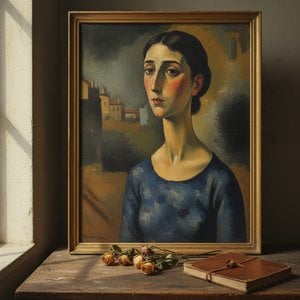
Alberto Sughi: A Life Painted in the Shadows of Reality
Born in Cesena, Italy, in 1928, Alberto Sughi’s artistic journey wasn't one of grand pronouncements or revolutionary gestures, but rather a quiet, persistent exploration of the everyday – the mundane moments and subtle emotions that constitute human existence. He began his artistic life not with formal training, but through a deeply personal engagement with the world around him, absorbing influences from Surrealism’s dreamlike imagery and Expressionism's raw emotionality. Yet, Sughi ultimately forged a distinct path, establishing himself as a master of what he termed “existential realism,” a style characterized by its unflinching honesty and profound psychological depth.
Early in his career, Sughi deliberately resisted the prevailing trends of post-war art, rejecting both idealized romanticism and abstract formalism. Instead, he focused on depicting scenes from ordinary life – interiors bathed in twilight, solitary figures lost in thought, glimpses of family moments—with a meticulous attention to detail and a remarkable ability to capture the essence of his subjects. Enrico Crispolti famously described Sughi’s work as “existential realism” in 1956, recognizing that his paintings weren't merely representations of reality but rather explorations of human experience, imbued with an underlying sense of melancholy and introspection. This approach wasn’t about judgment or moralizing; it was a commitment to observing and portraying the world as it truly is, revealing the complexities and contradictions inherent in the human condition.
The Development of Existential Realism
Sughi's distinctive style evolved gradually over several decades. Initially, his work leaned towards a more traditional realism, but he soon began to employ techniques that heightened the emotional impact of his scenes. He utilized dramatic lighting—often employing chiaroscuro—to create a sense of mystery and suspense, drawing viewers into the intimate spaces of his paintings. His color palettes were typically muted and subdued, dominated by earthy tones and subtle gradations of gray, reflecting the quiet introspection of his subjects. Crucially, Sughi avoided any overt symbolism or narrative elements, allowing the viewer to project their own interpretations onto the scenes he presented.
The cyclical nature of many of Sughi’s series—such as the “Supper” cycle and “Imagination and Memory of the Family”—further emphasized his approach. These recurring themes allowed him to delve deeper into specific aspects of human experience, exploring relationships, memories, and the passage of time with a sustained focus. He wasn't simply painting individual scenes; he was constructing narratives through repetition and variation, creating a sense of continuity and emotional resonance.
Major Works and Exhibitions
Throughout his career, Sughi participated in numerous prestigious exhibitions, both nationally and internationally. His work has been featured in major museums across Italy and abroad, including the Galleria Moderna in Bologna, the Manezh Gallery in Moscow, the Castel Sant’Angelo Museum in Rome, and the National Gallery in Prague. Significant retrospectives have highlighted his evolution as an artist, showcasing the breadth of his subject matter and stylistic development.
Among his most celebrated works are “Rimmel” (2004), a haunting depiction of a solitary figure bathed in shadow, and the series "Evening or Reflection," which captures the quiet beauty of twilight landscapes. His later paintings continued to explore themes of memory, loss, and the passage of time, reflecting a lifetime spent observing and interpreting the complexities of human existence. The 2007 exhibitions at the Biblioteca Malatestiana in Cesena and the Complesso Vittoriano in Rome offered a comprehensive overview of his artistic legacy, solidifying his position as one of Italy’s most important contemporary artists.
Legacy and Influence
Alberto Sughi's influence extends beyond the realm of Italian art. His commitment to honest observation and psychological depth has resonated with artists around the world who seek to capture the essence of human experience. His work serves as a reminder that profound beauty can be found in the simplest of moments, and that true art lies not in grand gestures but in the quiet contemplation of reality.
Sughi’s legacy is one of understated brilliance—a testament to the power of observation, empathy, and a deep understanding of the human heart. He died in Bologna in 2012, leaving behind a body of work that continues to captivate and challenge viewers with its quiet intensity and profound emotional resonance.
Q&A
Alberto Siuffi 작품의 연도별 타임라인이 있나요?
Alberto Siuffi의 작품 연표를 확인해 보세요: 작품 연대기 페이지에서 작품들을 제작 날짜순으로 보실 수 있습니다.
Alberto Siuffi 작가의 다른 활동명이나 알려진 이름이 있나요?
Alberto Siuffi은(는) Alberto Bruschi, Alberto Sughi(으)로도 알려져 있습니다.
Alberto Siuffi의 작품을 분위기별로 모아둔 곳은 어디인가요?
아티스트의 무드 룸 페이지에서는 Alberto Siuffi의 작품들을 분위기에 따라 큐레이션된 형태로 만나보실 수 있습니다.
Alberto Siuffi가 그린 모든 주제를 한눈에 볼 수 있는 개요가 있나요?
주제별 작품 모음 페이지에서는 Alberto Siuffi의 작품들을 주제별로 확인하실 수 있습니다.