A life shaped by the brush
Adolphe Félix Cals came from a humble family where his parents worked to keep him away from manual labor. His early years were spent learning the precise, careful craft of engraving under Jean-Louis Anselin. When Anselin passed away, the path continued through the hands of Ponce and Bosc, eventually leading him to the studio of Léon Cogniet at the École des Beaux-Arts. This period was marked by a quiet friction between teacher and pupil. While Cogniet pushed for a more popular, accessible style, Cals chose to follow his own inclinations, even when it meant facing professional uncertainty.
The years were not always easy. For a long time, he relied on the help of an art dealer named Martin to sell canvases and find enough work to live. It was only when he reached fifty that his circumstances shifted, aided by the support of Count Doria. Living at the Château d’Orrouy provided a reprieve from financial pressure, allowing him to focus entirely on his painting. He spent much of his later life moving between Paris and Honfleur, eventually settling in the latter port with his daughter, Marie.
The textures of Normandy
His work often looks back at the landscapes and people of the coast. In Honfleur, he found subjects in the harbor, the sea, and the daily lives of those who worked upon it. His paintings of peasants and sailors carry a certain weight, showing a deep interest in the lives of the poor. He did not shy away from the reality of rural life, as seen in works like Peasant Woman and Child.
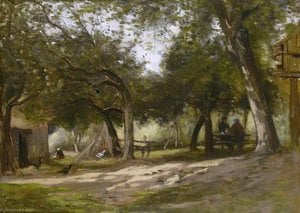
The way he applied paint changed as he moved through different influences. Influenced by the likes of Corot and Jongkind, his palette often leaned toward muted tones—greys, browns, and dark greens. He was sometimes called a "grey Impressionist" because he avoided the bright, saturated colors used by others. Instead, he used short, regular strokes to capture the movement of air and light. His touch could be broad and rough or delicate and light, particularly when painting orchards or farmyards like those at Saint-Siméon.
A place in the changing light
Cals occupied a space between older traditions and the new movements emerging in France. He participated in several Impressionist exhibitions, including the first one in 1874, and continued to show his work through the late 1870s. His presence at the Salon des Refusés in 1863 placed him alongside figures like Monet and Degas during a time of great artistic transition.
His later years were spent amidst a circle of painters at the Saint-Siméon farm, a frequent meeting place for many artists of his era. Though he remained true to his own subdued style, his work helped bridge the gap between the academic past and the more spontaneous approach of the future. He died in Honfleur in 1880, leaving behind a body of work that captured the quiet, heavy atmosphere of the French landscape.
질의응답
Adolphe Félix Cals의 작품을 분위기별로 찾아볼 수 있나요?
아티스트의 무드 룸 페이지에서는 Adolphe Félix Cals의 작품들을 분위기에 따라 큐레이션된 형태로 만나보실 수 있습니다.
Adolphe Félix Cals의 작품 중 조회수가 가장 높은 것은 무엇인가요?
Adolphe Félix Cals의 작품에 관한 통계를 보여주는 통계 페이지가 본 웹사이트에 마련되어 있습니다.
Adolphe Félix Cals 작가의 작품을 감상할 수 있는 가상 박물관에 방문할 수 있나요?
Adolphe Félix Cals의 작품은 작가의 3D 뮤지엄 페이지에 마련된 3D 갤러리에서 감상하실 수 있습니다.