GraphiteWallArtAmerican Realism
 187819th Century
 9.0 x 22.0 cm
원하는 크기와 액자로 주문 제작되는, 작가들이 직접 캔버스에 손으로 그린 유화 작품입니다. ( 프린트 판매로 전환 디지털 이미지로 전환)





























작품의 원본 비율을 유지하는 미리 설정된 크기 중에서 선택하세요.

특정 프레임이나 공간에 맞도록 직접 크기를 입력할 수 있습니다. 선택하신 크기가 원본 이미지의 비율과 일치하지 않는 경우, 작품을 자르거나 추가적인 손으로 그린 요소를 사용하여 그림을 확장합니다. 제작 시작 전 승인을 위해 디지털 목업을 보내드립니다.
화면 미리 보기는 실제 자르기 또는 확장을 반영하지 않습니다. 최종 구성은 목업을 통해서만 정확하게 확인하실 수 있습니다.
맞춤 크기 제작도 가능하지만, 원본 비율을 유지하기 위해 사전 정의된 목록에서 크기를 선택하시는 것을 권장합니다.

Sheep
복제본 크기
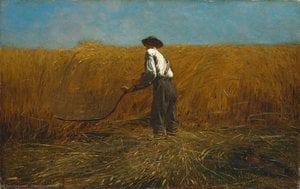
In the vast tapestry of American Realism, few works capture the profound stillness of rural existence as poignantly as Winslow Homer’s 1878 masterpiece, “Sheep.” This is not merely a depiction of livestock grazing in a meadow; it is a distilled essence of the American spirit—a quiet observation of pastoral life imbued with an understated, almost monumental grandeur. Through his masterful command of tonal shading and textural detail, Homer invites the viewer into a world where time seems to decelerate, allowing for a deep, meditative connection with the landscape. Executed with a delicate yet powerful hand in dark graphite and white gouache on vat-dyed wove paper, the piece transcends its simple subject matter to become a window into the soul of late 19th-century New England.
The composition presents a flock of sheep scattered across a sunlit meadow, their forms rendered with such precision that one can almost feel the weight of their presence against the earth. Homer deliberately eschewed the grand, sweeping historical narratives favored by many of his contemporaries, choosing instead to find the extraordinary within the ordinary. By focusing on these everyday scenes, he established a visual language rooted in authenticity and truth. The technique is nothing short of remarkable; the graphite underdrawing provides a sturdy, structural foundation, while the application of white gouache lends a luminous quality to the composition. This interplay of light and shadow creates a breathtaking illusion of three-dimensionality, drawing the eye through the depth of the field and making the sheep appear as tangible, living entities standing upon the textured ground.
Beyond its immediate visual charm, “Sheep” carries a profound symbolic weight that resonates with the themes of the Romantic movement. Throughout art history, sheep have served as enduring symbols of innocence, simplicity, and pastoral tranquility. In this work, Homer utilizes these archetypes to evoke a sense of peace and stability, offering a serene counterpoint to the burgeoning industrialization of the era. The painting captures a quintessential image of rural life that feels both timeless and deeply rooted in a specific historical moment. There is a wistful beauty in the way the light touches the fleece, suggesting a world of quiet dignity and unhurried rhythms.
For the discerning collector or interior designer, this artwork offers more than just aesthetic pleasure; it provides an emotional anchor. The monochromatic palette, characterized by its classic and timeless appearance, allows the piece to integrate seamlessly into a variety of sophisticated environments. Whether placed in a sun-drenched gallery or a moody, contemporary study, the high contrast and masterful shading of Homer’s work command attention without overwhelming the space. It is an invitation to pause, to breathe, and to rediscover the beauty found in the most humble corners of the natural world.


1836 - 1910 , 미국

Explore the profound beauty of American art history. From the Hudson River School to iconic landscapes, discover a curated journey through the masterpieces that defined a nation's spirit and the enduring legacy of American Romanticism.

Explore the profound beauty of American Realism. From Winslow Homer’s rural landscapes to the dignity of everyday life, discover how master artists captured the soul of a nation through evocative oil paintings and timeless fine art techniques.


 미리보기
미리보기
 공유하기
공유하기 공유하기
공유하기
 상세 정보
상세 정보

 다운로드
다운로드
 유사 작품
유사 작품 X-레이
X-레이 슬라이드 쇼
 통계 정보
통계 정보 더 보기
더 보기









 유리 옵션은 110cm 미만 크기에서만 선택 가능합니다.


![Indian Tobacco Shop Sign [reverse, Indian Facing Right] — 윈슬로우 호머, Contemporary Realism](/media/artworks/images-thumb/74/22/7422432cafc295265ef3b7f7fa62d35d.jpg)