
x


 51.0 x 77.0 cm
 Guildhall Art Gallery
작품의 원본 비율을 유지하는 미리 설정된 크기 중에서 선택하세요.

특정 프레임이나 공간에 맞도록 직접 크기를 입력할 수 있습니다. 선택하신 크기가 원본 이미지의 비율과 일치하지 않는 경우, 작품을 자르거나 추가적인 손으로 그린 요소를 사용하여 그림을 확장합니다. 제작 시작 전 승인을 위해 디지털 목업을 보내드립니다.
화면 미리 보기는 실제 자르기 또는 확장을 반영하지 않습니다. 최종 구성은 목업을 통해서만 정확하게 확인하실 수 있습니다.
맞춤 크기 제작도 가능하지만, 원본 비율을 유지하기 위해 사전 정의된 목록에서 크기를 선택하시는 것을 권장합니다.

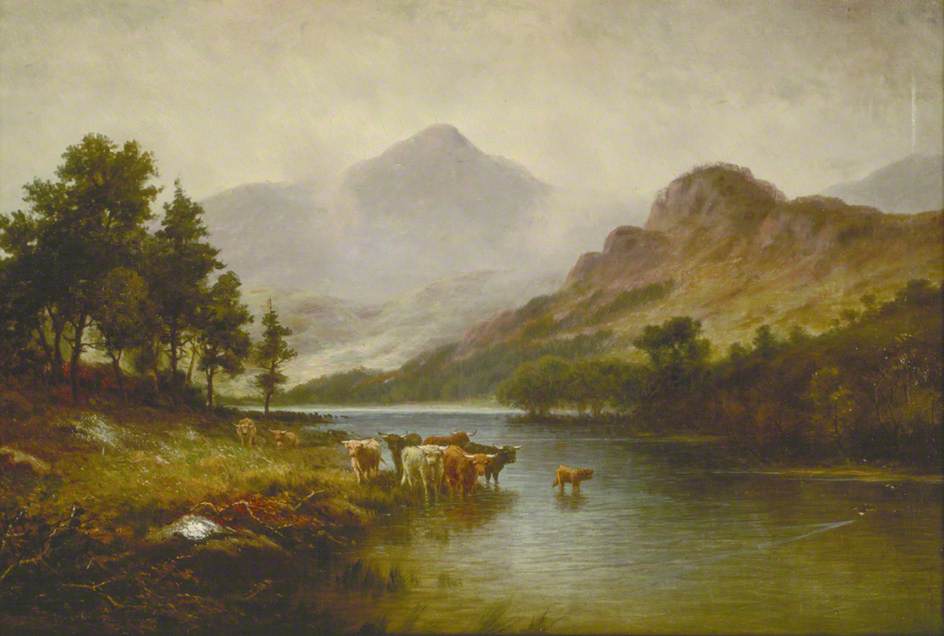
Highland Cattle in a River Landscape
복제본 크기

The history of Victorian Scotland is often told through the lens of industrial progress, yet there exists a parallel narrative written in the luminous oils and dramatic vistas of William Glover. Born on November 4, 1836, in Croydon, South London, to a family deeply rooted in the theatrical arts, Glover’s life was an intricate tapestry woven from the threads of stagecraft and fine art. Though his beginnings were in England, his soul became inextricably linked to the Scottish landscape. As the son of the esteemed actor and theatre manager Edmund Glover, William was raised amidst the magic of the footlights, a heritage that would later inform his unique ability to transform a flat canvas into a breathing, theatrical world.
Glover’s artistic journey was marked by a profound transition from the ephemeral beauty of the stage to the enduring permanence of landscape painting. After honing his skills through rigorous self-study and formal training at the Glasgow School of Art in 1859, he emerged as a master of visual storytelling. His early years were defined by an apprenticeship to light and shadow, a skill set perfected while working as a scenic painter. In this role, he learned to manipulate scale and perspective to create immersive environments for the theatre, a technique that would eventually breathe life into his most celebrated landscape works. His professional ascent in Glasgow’s theatrical scene was nothing short of meteoric; he became a pivotal figure in the management of the Glasgow Theatre Royal, helping to establish it as a cornerstone of British entertainment.
What distinguishes Glover from his contemporaries is the unmistakable presence of the theatrical within his naturalism. To gaze upon a Glover landscape is to witness a carefully composed drama where nature itself takes center stage. His experience as a stage manager allowed him to approach the Scottish Highlands not merely as a topographical subject, but as a set designed to evoke profound emotional responses. He possessed an uncanny ability to use color and light to direct the viewer's eye, much like a spotlight illuminating a protagonist in a darkened theatre.
His mastery of scenic painting provided him with a unique technical vocabulary. He understood how to create depth through atmospheric perspective, using soft, hazy tones to suggest distant mountains and sharp, vibrant details to ground the foreground. This duality—the ability to capture both the grand, sweeping vistas of the Highlands and the intimate, fleeting moments of light—allowed him to bridge the gap between the monumental and the mundane. His works often feature:
As his career progressed, Glover’s reputation as a landscape painter solidified, moving beyond the confines of the theatre into the prestigious galleries of Scotland. His paintings, such as The River Kelvin from the North at the Botanic Gardens and Meikle Earnock Village, serve as vital historical documents of a bygone era. Through his brush, we see the rural rhythms of the late 19th century—the horse-drawn carriages, the bustling village streets, and the serene, untouched beauty of the Scottish countryside before the full weight of industrialization took hold.
The significance of William Glover lies in his ability to have captured the sublime. He did not merely paint what he saw; he painted how it felt to stand amidst the grandeur of the Highlands. His work remains a testament to the Victorian era's fascination with nature and its romanticized connection to heritage. Though he passed away in 1916, his legacy persists in the collections of museums like the Low Parks Museum, where his canvases continue to invite viewers into a world of theatrical beauty and enduring Scottish spirit. He remains a singular figure—an artist who brought the drama of the stage to the quiet majesty of the earth.

1836 - 1916


최신 미술 뉴스, 특별 혜택 및 인테리어 아이디어를 가장 먼저 만나보세요.
프로젝트에 대해 알려주시면 저희 미술 전문가들이 맞춤형 아트 제안 3가지를 전달해 드립니다.
당신만을 위한 맞춤형 옵션 3가지를 무료로 추천해 드립니다!

 미리보기
미리보기
 프린트 구매
 공유하기
공유하기 공유하기
공유하기
 상세 정보
상세 정보

 다운로드
다운로드
 유사 작품
유사 작품 X-레이
X-레이 슬라이드 쇼
 더 보기
더 보기






































 유리 옵션은 110cm 미만 크기에서만 선택 가능합니다.


