
x


 1877
1877 56.0 x 100.0 cm
작품의 원본 비율을 유지하는 미리 설정된 크기 중에서 선택하세요.

특정 프레임이나 공간에 맞도록 직접 크기를 입력할 수 있습니다. 선택하신 크기가 원본 이미지의 비율과 일치하지 않는 경우, 작품을 자르거나 추가적인 손으로 그린 요소를 사용하여 그림을 확장합니다. 제작 시작 전 승인을 위해 디지털 목업을 보내드립니다.
화면 미리 보기는 실제 자르기 또는 확장을 반영하지 않습니다. 최종 구성은 목업을 통해서만 정확하게 확인하실 수 있습니다.
맞춤 크기 제작도 가능하지만, 원본 비율을 유지하기 위해 사전 정의된 목록에서 크기를 선택하시는 것을 권장합니다.

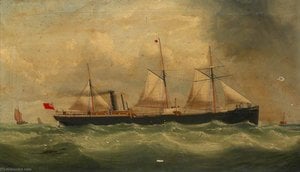
SS 'Durham'
복제본 크기

Born in 1834 amidst the salt-sprayed landscapes of Caistor, Lincolnshire, William Daniel Penny emerged as a profound voice in British marine art during the height of the Victorian era. This was an age defined by the relentless pulse of industrial expansion and a romantic fascination with the untamed sea. Penny’s artistic journey found its true north in the rugged coastal stretches of Yorkshire, particularly around Grimsby. It was here, amidst the rhythmic toil of fishing fleets and the shifting tides of the Humber Estuary, that he established himself not merely as a painter, and later as the proprietor of ‘The Artist’s Rest,’ but as a dedicated chronicler of maritime life. His early years in this maritime hub provided him with an intimate, firsthand understanding of the sea's dual nature—both its serene beauty and its terrifying volatility.
While much of his formal training remains shrouded in the mists of history, anecdotal accounts suggest that Penny was a master of self-study, refining his craft through keen observation and the mentorship of contemporary peers. His development as an artist was deeply intertwined with the geography of the Humber. The estuary became his primary muse, providing a constant stream of subjects ranging from humble fishing smacks to larger, more imposing vessels. He possessed a rare ability to look beyond the mere physical structure of a ship, seeking instead to capture the very soul of the maritime environment through meticulous detail and an advanced use of atmospheric perspective.
The true brilliance of Penny’s work lies in his embrace of Luminism, a stylistic movement that prioritized the subtle gradations of light to evoke deep emotional resonance. Influenced by the works of masters such as Frederic Church and Asher Durand, Penny moved away from stark photographic realism toward a more poetic interpretation of the natural world. He utilized diffused light and tonal shifts to convey the heavy humidity of a coastal morning or the dramatic tension of an approaching storm. This dedication to capturing the essence of atmosphere allowed his canvases to breathe with a palpable sense of life.
In his most celebrated compositions, one can witness this mastery of light and texture. His technique often involved:
The significance of William Daniel Penny’s oeuvre extends far beyond simple maritime documentation; his works serve as a visual archive of a vanishing way of life. Through masterpieces such as SS 'Prospero', which depicts the struggle of a trawler against turbulent waters, and Top Sail Schooner on the Humber, which offers a moment of profound tranquility, he captured the heartbeat of the British fishing industry. His ability to oscillate between the dramatic and the serene allowed him to document the full spectrum of the human experience at sea.
Today, his contributions are preserved in esteemed institutions like the Hull Maritime Museum, ensuring that his vision of the Victorian maritime landscape remains accessible to future generations. Penny’s legacy is one of profound connection—a bridge between the observer and the infinite horizon, reminding us of the enduring, powerful bond between humanity and the sea. His paintings remain not just studies of ships and water, but evocative meditations on the beauty, danger, and majesty of the maritime world.
1834 - 1924


최신 미술 뉴스, 특별 혜택 및 인테리어 아이디어를 가장 먼저 만나보세요.
프로젝트에 대해 알려주시면 저희 미술 전문가들이 맞춤형 아트 제안 3가지를 전달해 드립니다.
당신만을 위한 맞춤형 옵션 3가지를 무료로 추천해 드립니다!


 미리보기
미리보기
 프린트 구매
 공유하기
공유하기 공유하기
공유하기
 상세 정보
상세 정보

 다운로드
다운로드
 유사 작품
유사 작품 X-레이
X-레이 슬라이드 쇼
 더 보기
더 보기






































 유리 옵션은 110cm 미만 크기에서만 선택 가능합니다.


