빠른 제작과 다양한 마감 옵션을 제공하는 박물관 품질의 지클레이 또는 캔버스 프린트. ( 손으로 그린 그림 구매 이미지 구매)





























작품의 원본 비율을 유지하는 미리 설정된 크기 중에서 선택하세요.

특정 프레임이나 공간에 맞춰 직접 치수를 입력하실 수 있습니다. 선택하신 사이즈가 원본 이미지의 비율과 일치하지 않을 경우, 작품을 크롭(자르기)하거나 이미지를 대칭 또는 단색 채우기로 확장하여 제작합니다. 제작 시작 전, 최종 확인을 위해 디지털 목업이 전송됩니다.
화면상의 미리보기는 실제 크롭이나 확장 상태를 반영하지 않으므로, 최종 구도는 오직 목업을 통해서만 정확하게 확인하실 수 있습니다.
맞춤 사이즈 제작도 가능하지만, 원본 비율을 유지하기 위해서는 사전 정의된 목록에서 치수를 선택하시는 것을 권장합니다.

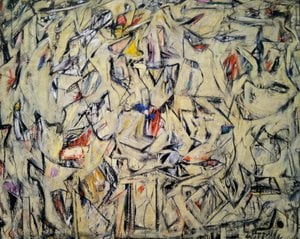
Whose Name Was Writ in Water
복제본 크기
Willem de Kooning's "Whose Name Was Writ in Water," painted in 1975, is a powerfully evocative work that encapsulates the core tenets of Abstract Expressionism – a movement he helped define. This close-up view reveals not just paint on canvas, but a visceral outpouring of emotion and a deliberate disruption of traditional artistic representation. The painting’s dynamism stems from de Kooning's masterful manipulation of color and texture, creating a surface that seems to writhe with energy. Dominating the composition are bold strokes of red and blue, interwoven with strategic accents of green, yellow, and white – colors he frequently employed to convey intense psychological states. The title itself, “Whose Name Was Writ in Water,” adds another layer of complexity, hinting at themes of memory, loss, and perhaps even the elusive nature of identity.
De Kooning's technique is immediately apparent in this piece. The application of paint is anything but smooth; it’s deliberately rough, fragmented, and layered. Thick impasto – built-up areas of heavy paint – creates a tactile surface that demands attention. He employed a vigorous, almost violent brushstroke, often applying the paint with a palette knife as much as with his brushes. This technique wasn't simply about creating an image; it was about imbuing the canvas with feeling. The visible brushstrokes aren’t accidental; they are deliberate marks of energy and struggle, reflecting de Kooning’s own turbulent emotional landscape. The close-up view allows us to appreciate the sheer physicality of his process – a testament to his commitment to expressive abstraction.
"Whose Name Was Writ in Water" was created during a pivotal moment in art history, roughly halfway through de Kooning’s career. Following his early figurative work, particularly his iconic "Woman" series, he increasingly embraced abstraction, though always retaining a raw, almost confrontational quality. This painting reflects the broader trends of Abstract Expressionism – a movement born out of the anxieties and uncertainties of post-World War II America. Artists like de Kooning sought to express fundamental human emotions through non-representational forms, rejecting traditional notions of beauty and harmony. De Kooning’s work stands as a crucial bridge between his earlier explorations of figuration and his later, more purely abstract endeavors, showcasing the evolution of one of art's most influential figures.
The title itself is laden with potential symbolism. "Writ in Water" suggests something fleeting, ephemeral – perhaps a memory fading away or an attempt to capture a moment that’s inherently unstable. The dominant colors—red for passion and violence, blue for melancholy and introspection—contribute to the painting's overall mood of unease and intensity. Ultimately, “Whose Name Was Writ in Water” is not about literal representation; it’s about conveying an emotional state – a feeling of disorientation, struggle, and perhaps even a desperate search for meaning. It invites viewers to confront their own anxieties and grapple with the complexities of human experience.


1904 - 1997 , 네덜란드

추상표현주의의 심장을 뛰게 한 10대 걸작을 만나보세요. 폴록, 로스코 등 거장의 작품 비하인드 스토리와 예술적 영감을 WahooArt에서! 지금 바로 미술품 컬렉션을 탐험하고, 당신의 공간에 특별한 예술적 감성을 더하세요. WahooArt.com

Journey through Wassily Kandinsky's 25 most iconic abstract paintings. Explore his revolutionary use of color, form & spiritual expressionism. Find museum-quality Kandinsky reproductions and elevate your home decor with WahooArt.com. Discover all masterpieces on WahooArt.com!

고야의 걸작 25선을 만나보세요. 스페인 화가 Francisco Goya의 낭만주의 회화, 어두운 색조와 강렬한 감성이 담긴 명화를 WahooArt에서 감상하세요. 고품질 유화 복제본으로 예술 작품을 소장하고 홈 데코를 완성해보세요! 지금 바로 컬렉션을 탐험하세요.

Immerse yourself in the captivating world of slate blue! Explore 10 iconic paintings by Monet, Van Gogh & Renoir. Discover their stories, techniques & find museum-quality art reproductions for your home at .

Explore the evolution of Willem de Kooning's iconic Abstract Expressionist paintings. Discover his signature style, key themes & investment potential with expert insights for discerning art collectors.


 미리보기
미리보기
 공유하기
공유하기 공유하기
공유하기
 상세 정보
상세 정보

 다운로드
다운로드
 유사 작품
유사 작품 X-레이
X-레이 슬라이드 쇼

 더 보기
더 보기









 유리 옵션은 110cm 미만 크기에서만 선택 가능합니다.