빠른 제작과 다양한 마감 옵션을 제공하는 박물관 품질의 지클레이 또는 캔버스 프린트. ( 손으로 그린 그림 구매 디지털 이미지로 전환)





























작품의 원본 비율을 유지하는 미리 설정된 크기 중에서 선택하세요.

특정 프레임이나 공간에 맞춰 직접 치수를 입력하실 수 있습니다. 선택하신 사이즈가 원본 이미지의 비율과 일치하지 않을 경우, 작품을 크롭(자르기)하거나 이미지를 대칭 또는 단색 채우기로 확장하여 제작합니다. 제작 시작 전, 최종 확인을 위해 디지털 목업이 전송됩니다.
화면상의 미리보기는 실제 크롭이나 확장 상태를 반영하지 않으므로, 최종 구도는 오직 목업을 통해서만 정확하게 확인하실 수 있습니다.
맞춤 사이즈 제작도 가능하지만, 원본 비율을 유지하기 위해서는 사전 정의된 목록에서 치수를 선택하시는 것을 권장합니다.

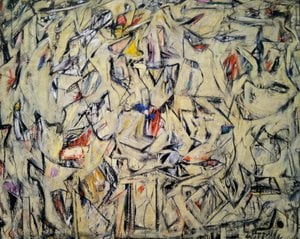
Brooding Woman
복제본 크기
In the pantheon of twentieth-century masterpieces, few works command the room with such raw, unbridled energy as Willem de Kooning’s Brooding Woman. Created in 1965, this painting serves as a profound window into the psyche, transcending mere portraiture to become an intensely visceral exploration of human vulnerability and psychological complexity. To encounter this work is not simply to observe a figure on canvas, but to feel the rhythmic pulse of its creation. De Kooning, a titan of the Abstract Expressionist movement, utilizes the medium to translate internal turbulence into a visible, tactile experience. The subject—a female form emerging from a sea of chaotic motion—acts as an anchor for the viewer amidst a whirlwind of color and texture, making it a captivating focal point for any sophisticated collection or curated interior space.
The brilliance of the piece lies in its masterful command of impasto and gestural movement. De Kooning eschews the polite boundaries of traditional representation, opting instead for thick, audacious layers of paint that lend the surface a sculptural quality. The technique is unapologetically energetic; swirling, loose brushstrokes dance across the canvas, creating a sense of perpetual motion that mirrors the restless spirit of the subject. A striking palette dominates the composition, where the soft, emotive pinks of the woman’s face are dramatically juxtaposed against earthy browns, deep greens, and sudden bursts of vibrant light. This deliberate chromatic tension does more than please the eye; it amplifies the painting's emotional resonance, mirroring the disorientation and profound depth of the human condition.
To understand Brooding Woman, one must look to the historical crucible of post-World War II New York. As a central figure of the New York School, de Kooning was part of a revolutionary wave of artists—including Jackson Pollock and Mark Rothko—who sought to liberate art from the constraints of literal depiction. This era prioritized the act of painting itself as a form of "action," where every stroke recorded the artist's physical and emotional struggle. In this context, the "brooding" nature of the subject is not merely a thematic choice but a reflection of the era's preoccupation with existentialism and the search for meaning in a fractured world. The painting captures that precise moment of tension between form and abstraction, making it an enduring icon of modern art history.
For the discerning collector or interior designer, a high-quality reproduction of this work offers more than just aesthetic beauty; it provides a conversational centerpiece that breathes life into a room. The artwork’s ability to balance chaotic energy with a structured focal point allows it to integrate seamlessly into both contemporary minimalist settings and richly textured, classical environments. It invites contemplation, prompting viewers to linger on its layered depths and find their own reflections within its turbulent beauty. Owning a piece of this magnitude is an opportunity to surround oneself with the very essence of artistic rebellion and the timeless, beautiful struggle of the human spirit.


1904 - 1997 , 네덜란드

Explore the profound emotional depth of Abstract Expressionism. From Pollock's dynamic drips to de Kooning's gestural mastery, our expert guide offers art collectors a sophisticated analysis of this transformative movement and its enduring legacy in modern fine art.


 미리보기
미리보기
 공유하기
공유하기 공유하기
공유하기
 상세 정보
상세 정보 가이드 보기

 다운로드
다운로드
 유사 작품
유사 작품 X-레이
X-레이 슬라이드 쇼
 통계 정보
통계 정보

 더 보기
더 보기









 유리 옵션은 110cm 미만 크기에서만 선택 가능합니다.