원하는 크기와 액자로 주문 제작되는, 작가들이 직접 캔버스에 손으로 그린 유화 작품입니다. ( 프린트 판매로 전환 디지털 이미지로 전환)





























작품의 원본 비율을 유지하는 미리 설정된 크기 중에서 선택하세요.

특정 프레임이나 공간에 맞도록 직접 크기를 입력할 수 있습니다. 선택하신 크기가 원본 이미지의 비율과 일치하지 않는 경우, 작품을 자르거나 추가적인 손으로 그린 요소를 사용하여 그림을 확장합니다. 제작 시작 전 승인을 위해 디지털 목업을 보내드립니다.
화면 미리 보기는 실제 자르기 또는 확장을 반영하지 않습니다. 최종 구성은 목업을 통해서만 정확하게 확인하실 수 있습니다.
맞춤 크기 제작도 가능하지만, 원본 비율을 유지하기 위해 사전 정의된 목록에서 크기를 선택하시는 것을 권장합니다.

Zett-Ka
복제본 크기
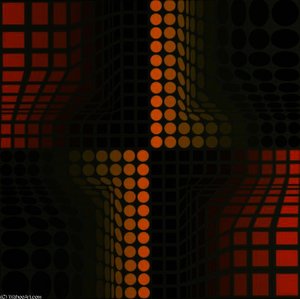
To stand before Victor Vasarely's Zett-Ka is not merely to observe a painting; it is to step into a meticulously constructed optical puzzle. This masterful piece, a quintessential beacon of the Op-Art movement, immediately arrests the viewer with its vibrant interplay of color and geometry. The eye cannot settle on one point for long, instead being drawn across the surface by an almost palpable sense of visual vibration. At its heart lies a commanding blue and red sphere, not solid in its appearance, but rather suggested through countless smaller circles and patterned elements. These constituent parts work together to create an illusion of depth and movement that seems to breathe with the viewer's own gaze.
Vasarely’s genius lies in his ability to translate abstract mathematical principles into visceral, emotional art. The Op-Art style, which blossomed in the 1960s, was a direct intellectual response to modern life—a celebration of structure, pattern, and the very mechanics of human sight. In Zett-Ka, this is evident in the rigorous arrangement of its patterned surface. It speaks to an era fascinated by science and perception, where art could engage with physics as much as emotion. The composition itself is a sophisticated dance between order and perceived chaos; the geometric precision suggests intellect, while the resulting visual flutter evokes a more primal, almost dizzying sensory experience.
This work stands firmly within a rich lineage of artistic inquiry that questions the nature of reality. Vasarely, whose career spanned decades of avant-garde exploration, utilized geometry as his primary tool for philosophical questioning. One cannot discuss Zett-Ka without acknowledging its conversation with contemporaries and predecessors who dared to challenge pictorial space. The echoes of Bridget Riley’s mesmerizing patterns or the thoughtful color juxtapositions found in Gershon Iskowitz's work resonate here, confirming Op Art’s status as a pivotal moment in modern art history. It is an artwork that demands scholarly appreciation while remaining immediately accessible to the casual admirer.
For the collector or designer seeking a piece that transcends mere decoration, Zett-Ka offers unparalleled dynamism. Reproducing this work allows one to incorporate a focal point of intellectual energy into any space. Imagine its bold blue and passionate red hues set against a neutral wall—the painting itself becomes an active participant in the room's atmosphere. It is art that does not merely hang; it vibrates. Owning a reproduction of Zett-Ka means acquiring a piece of visual theory, a conversation starter, and a permanent source of optical delight for years to come.

1906 - 1997 , 크로아티아
Explore the mesmerizing world of Victor Vasarely. Discover how his Bauhaus-inspired Op Art masters the science of perception through geometric abstraction and vibrant color. A sophisticated guide for discerning art collectors seeking to understand the legacy of optical illusion.

Explore the profound spiritual depth of geometric abstraction. From Malevich's Suprematism to modern masters, our expert guide reveals how pure form and color command presence in fine art collections.

Explore the profound evolution of Neo-Abstract art. Discover how bold geometric forms, vibrant chromatic depth, and tactile textures redefine modern expression for the discerning collector seeking sophisticated, high-impact masterpieces for contemporary interiors.

Discover the profound beauty of abstract art. Our expert guide explores geometric abstraction, Op Art, and Expressionism, offering connoisseurs deep insights into collecting and curating powerful, non-representational masterpieces for sophisticated interiors.


 미리보기
미리보기
 공유하기
공유하기 공유하기
공유하기
 상세 정보
상세 정보 가이드 보기

 다운로드
다운로드
 유사 작품
유사 작품 X-레이
X-레이 슬라이드 쇼
 통계 정보
통계 정보
 더 보기
더 보기









 유리 옵션은 110cm 미만 크기에서만 선택 가능합니다.