빠른 제작과 다양한 마감 옵션을 제공하는 박물관 품질의 지클레이 또는 캔버스 프린트. ( 손으로 그린 그림 구매 이미지 구매)





























작품의 원본 비율을 유지하는 미리 설정된 크기 중에서 선택하세요.

특정 프레임이나 공간에 맞춰 직접 치수를 입력하실 수 있습니다. 선택하신 사이즈가 원본 이미지의 비율과 일치하지 않을 경우, 작품을 크롭(자르기)하거나 이미지를 대칭 또는 단색 채우기로 확장하여 제작합니다. 제작 시작 전, 최종 확인을 위해 디지털 목업이 전송됩니다.
화면상의 미리보기는 실제 크롭이나 확장 상태를 반영하지 않으므로, 최종 구도는 오직 목업을 통해서만 정확하게 확인하실 수 있습니다.
맞춤 사이즈 제작도 가능하지만, 원본 비율을 유지하기 위해서는 사전 정의된 목록에서 치수를 선택하시는 것을 권장합니다.

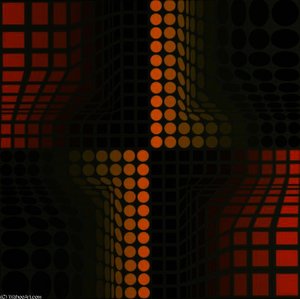
Zaphir 1
복제본 크기
Victor Vasarely’s "Zaphir 1" is more than just a painting; it's an experience, a visual exploration of perception and the power of geometric abstraction. This work, characteristic of Vasarely’s pioneering role in Op Art and Kinetic art, invites viewers into a world where circles—in vibrant hues of blue, green, yellow, orange, and punctuated by stark black—interact to create a dynamic, almost pulsating composition. The painting isn't about depicting a scene or object from the real world; instead, it’s an investigation into how our eyes and brains interpret patterns, shapes, and color relationships. It is a testament to Vasarely’s lifelong dedication to understanding and manipulating visual perception.
To truly appreciate "Zaphir 1," one must understand the journey of its creator. Born Károly Vásárhelyi in Pécs, Croatia (then part of Austria-Hungary), Victor Vasarely initially pursued medical studies before embracing his artistic calling. His formal training at the Podolini-Volkmann Academy and later Sándor Bortnyik’s workshop – deeply influenced by the Bauhaus movement – laid the foundation for his unique style. The Bauhaus ethos, with its emphasis on functional design and geometric abstraction, resonated profoundly with Vasarely's evolving vision. He wasn't interested in replicating reality; he sought to create a new visual language based on fundamental geometric principles. This pursuit led him to abandon traditional painting techniques in favor of a systematic approach, meticulously constructing his compositions from basic shapes—circles, squares, and triangles—arranged according to precise mathematical relationships.
“Zaphir 1” exemplifies Vasarely’s mastery of optical illusion. The arrangement of the circles – varying in size and position – isn't random; it is carefully calculated to create a sense of depth, movement, and vibration. The contrasting colors further amplify this effect, playing tricks on the eye and blurring the boundaries between the individual shapes. It’s as if the circles are not static forms but rather spheres suspended in space, gently rotating or expanding. Vasarely's technique involved layering these geometric elements with precision, creating a complex interplay of positive and negative space that draws the viewer into an immersive visual experience. He aimed to create art that wasn't merely seen but *felt*, engaging the senses and challenging conventional notions of perception.
While seemingly abstract, Vasarely’s work carries a deeper symbolic weight. His systematic approach was not just about aesthetics; it was also rooted in his belief that art should be accessible to everyone. He envisioned a world where art wasn't confined to museums or galleries but integrated into everyday life—enhancing urban spaces and enriching the human environment. The circles themselves can be interpreted as symbols of wholeness, continuity, and interconnectedness – universal themes that resonate across cultures. "Zaphir 1," therefore, becomes more than just a visually striking composition; it’s a statement about the power of art to inspire, engage, and democratize visual experience. It is an invitation to see the world through a new lens—one shaped by geometry, color, and the boundless possibilities of human perception.

1906 - 1997 , 크로아티아
Explore the mesmerizing world of Victor Vasarely. Discover how his Bauhaus-inspired Op Art masters the science of perception through geometric abstraction and vibrant color. A sophisticated guide for discerning art collectors seeking to understand the legacy of optical illusion.

Embark on a visual journey through the mesmerizing world of Op Art. Discover the masters of optical illusion, explore geometric abstraction, and learn how to curate high-impact kinetic works for your private collection with expert guidance from art professionals.

Explore the profound spiritual depth of geometric abstraction. From Malevich's Suprematism to modern masters, our expert guide reveals how pure form and color command presence in fine art collections.

Discover the profound beauty of abstract art. Our expert guide explores geometric abstraction, Op Art, and Expressionism, offering connoisseurs deep insights into collecting and curating powerful, non-representational masterpieces for sophisticated interiors.

Explore the profound evolution of Neo-Abstract art. Discover how bold geometric forms, vibrant chromatic depth, and tactile textures redefine modern expression for the discerning collector seeking sophisticated, high-impact masterpieces for contemporary interiors.


 미리보기
미리보기
 공유하기
공유하기 공유하기
공유하기
 상세 정보
상세 정보

 다운로드
다운로드
 유사 작품
유사 작품 X-레이
X-레이 슬라이드 쇼
 더 보기
더 보기









 유리 옵션은 110cm 미만 크기에서만 선택 가능합니다.