빠른 제작과 다양한 마감 옵션을 제공하는 박물관 품질의 지클레이 또는 캔버스 프린트. ( 손으로 그린 그림 구매 디지털 이미지로 전환)





























작품의 원본 비율을 유지하는 미리 설정된 크기 중에서 선택하세요.

특정 프레임이나 공간에 맞춰 직접 치수를 입력하실 수 있습니다. 선택하신 사이즈가 원본 이미지의 비율과 일치하지 않을 경우, 작품을 크롭(자르기)하거나 이미지를 대칭 또는 단색 채우기로 확장하여 제작합니다. 제작 시작 전, 최종 확인을 위해 디지털 목업이 전송됩니다.
화면상의 미리보기는 실제 크롭이나 확장 상태를 반영하지 않으므로, 최종 구도는 오직 목업을 통해서만 정확하게 확인하실 수 있습니다.
맞춤 사이즈 제작도 가능하지만, 원본 비율을 유지하기 위해서는 사전 정의된 목록에서 치수를 선택하시는 것을 권장합니다.

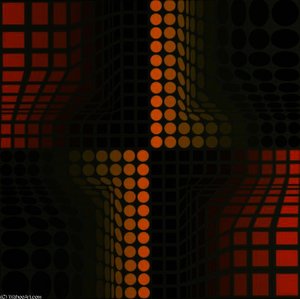
Uzok-III
복제본 크기
Victor Vasarely's 'Uzok-III,' painted in 1952, isn’t merely a visual experience; it’s an invitation to step into a world where perception itself is playfully challenged. This seminal work of Op Art—a movement that sought to disrupt the viewer’s sense of reality through optical illusions—radiates with a vibrant energy born from bold color contrasts and meticulously arranged geometric forms. More than just a static image, ‘Uzok-III’ feels like a contained explosion of dynamism, a testament to Vasarely's pioneering exploration of how we actually *see* the world.
Born in Pécs, Croatia (then part of Austria-Hungary), Vasarely’s artistic journey began unexpectedly. Initially pursuing medicine, he was drawn to the expressive potential of painting and, crucially, found mentorship with Sándor Bortnyik at Műhely – a school deeply rooted in the principles of Bauhaus design. This formative experience instilled within him a fascination with functional aesthetics and geometric abstraction, laying the foundation for his signature style. ‘Uzok-III’ embodies this legacy—a calculated interplay between order and chaos, precision and visual distortion.
At first glance, 'Uzok-III' presents a seemingly complex arrangement of interlocking triangles and quadrilaterals. However, beneath the surface lies a carefully orchestrated balance. The composition is largely symmetrical, yet deliberately asymmetrical elements prevent it from feeling static. Vasarely masterfully employs flat planes of color—striking reds, greens, blues/purples, and oranges—without any gradients or shading. This deliberate lack of illusionistic depth forces the viewer to confront the image directly, intensifying its optical effects. The pervasive texture, created by a dense pattern of tiny dots, isn’t merely decorative; it subtly softens the sharp edges of the geometric shapes, introducing an element of controlled randomness that further enhances the work's dynamism.
The absence of traditional perspective is key to understanding ‘Uzok-III.’ Vasarely deliberately avoids creating a sense of depth through linear recession. Instead, he relies on the overlapping and contrasting colors of the shapes to generate an illusion of spatial recession—a trick of the eye that draws the viewer into the composition without relying on conventional techniques. This technique is central to Op Art’s goal: to manipulate perception and create a disorienting yet captivating visual experience. The work feels simultaneously familiar and utterly alien, prompting us to question our own assumptions about how we interpret space and form.
'Uzok-III' is firmly rooted in the Op Art movement, but also reveals echoes of Constructivism—a Russian artistic movement that championed geometric abstraction and industrial aesthetics. The precise lines defining the shapes, combined with the bold color palette, speak to a desire for clarity and structure, while the dynamic arrangement suggests a more playful engagement with visual perception. Created using a screenprint or similar technique – likely ink on paper – this method allowed Vasarely to achieve the remarkable precision of the dot pattern and the vibrant intensity of the colors. It’s a testament to his meticulous approach and his understanding of how color and line can be used to manipulate our senses.
Ultimately, ‘Uzok-III’ is not about depicting anything recognizable; it's an exploration of pure form, color, and the very nature of perception. The work evokes a sense of energy, dynamism, and visual stimulation—a feeling that resonates with the viewer long after they’ve turned away. It’s a reminder that art doesn’t always need to represent reality to be profoundly impactful; sometimes, it simply needs to challenge our perceptions and invite us to see the world in a new way.

1906 - 1997 , 크로아티아

Explore the profound spiritual depth of geometric abstraction. From Malevich's Suprematism to modern masters, our expert guide reveals how pure form and color command presence in fine art collections.

Explore the profound world of optical art and masterpieces that redefine perception. From Vasarely’s geometric illusions to Farndon’s sensory reality, discover how legendary works challenge the eye and transform the viewer's experience through sophisticated abstraction.
Explore the mesmerizing world of Victor Vasarely. Discover how his Bauhaus-inspired Op Art masters the science of perception through geometric abstraction and vibrant color. A sophisticated guide for discerning art collectors seeking to understand the legacy of optical illusion.

Embark on a visual journey through the mesmerizing world of Op Art. Discover the masters of optical illusion, explore geometric abstraction, and learn how to curate high-impact kinetic works for your private collection with expert guidance from art professionals.

Discover the profound beauty of abstract art. Our expert guide explores geometric abstraction, Op Art, and Expressionism, offering connoisseurs deep insights into collecting and curating powerful, non-representational masterpieces for sophisticated interiors.


 미리보기
미리보기
 공유하기
공유하기 공유하기
공유하기
 상세 정보
상세 정보

 다운로드
다운로드
 유사 작품
유사 작품 X-레이
X-레이 슬라이드 쇼
 통계 정보
통계 정보

 더 보기
더 보기









 유리 옵션은 110cm 미만 크기에서만 선택 가능합니다.