이 페이지에 표시된 작품은 저작권법의 보호를 받으며, 이에 따라 동일한 복제품을 제작하거나 판매하는 것은 법으로 금지되어 있습니다. 이러한 권리 보호는 다음과 같은 국제 협약에 따라 시행됩니다. 베른 협약 또한 다음에서 명시하는 법률을 포함한 국내법에 의해 보호됩니다. 미국 저작권법 제17조.
이 방식은 저작권 보호를 받는 예술 작품을 복제하거나 그대로 재현하는 것이 아니기에 저작권 규정을 완벽히 준수합니다. 대신, 이는 창의적인 재해석의 과정을 거칩니다. 즉, 원작에서 영감을 받되 원작과 동일하지 않은 새로운 회화 작품을 의미합니다.
빠른 제작과 다양한 마감 옵션을 선택할 수 있는 박물관 수준의 지클레이 및 캔버스 프린트. ( 수작업 채색 복제본 주문하기 디지털 이미지 판매 채널로 전환)





























작품의 원본 비율을 그대로 유지하는 프리셋 사이즈 중에서 선택해 보세요.

액자나 벽면 크기에 맞춰 필요한 가로와 세로 길이를 입력해 주세요. 프린트는 원본 이미지보다 크게 제작할 수 없으며 오직 자르는 것만 가능하므로, 비율이 다른 사이즈를 선택할 경우 이미지의 일부가 잘려 나갈 수 있습니다. 인쇄 작업에 들어가기 전, 최종 확인을 위해 디지털 목업을 보내드립니다. 이 페이지에 표시된 이미지는 실제 잘리는 영역을 나타내지 않으며, 오직 목업을 통해서만 정확한 확인이 가능합니다.
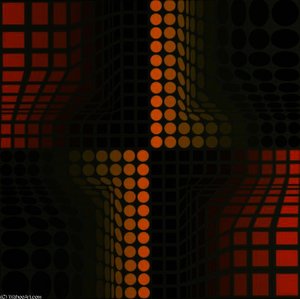
Sikra
복제본 규격
To encounter Victor Vasarely’s “Sikra” is to step away from the stillness of traditional viewing and enter a realm where the canvas breathes, pulses, and vibrates with an engineered energy. This masterpiece stands as a cornerstone of the Op Art movement—a revolution in visual perception that challenged the mid-20th century to reconsider the very mechanics of sight. The painting is not merely a static arrangement of pigment; it is an intellectual exploration into how our eyes interpret color and form, reflecting Vasarely's profound fascination with the intersection of mathematics and artistic expression. As the viewer engages with the work, the surface seems to undergo a rhythmic dance, creating a kinetic experience that transforms a flat plane into a dynamic, living entity.
The visual language of “Sikra” is built upon a foundation of meticulous geometric precision. The composition is dominated by a mesmerizing interplay of vibrant hues—bold blues juxtaposed against fiery reds, and sunny yellows dancing alongside verdant greens. Within this chromatic landscape, Vasarely employs a complex framework of circles, squares, and triangles. These shapes are not merely decorative elements; they embody mathematical concepts such as tessellations and fractals, where repeating geometric patterns create an illusion of depth and movement without the need for overlapping layers. Through the careful manipulation of color gradients and spatial relationships, Vasarely achieves a sense of structural tension, making the eye wander through a labyrinth of light and perceived motion.
The genesis of such groundbreaking work lies in the unique life journey of the artist himself. Born Károly Vaszary in 1906 in Pécs, Vasarely’s path toward becoming the "grandfather" of Op Art was anything but linear. Originally pursuing medical studies at Eötvös Loránd University, his transition to the fine arts in 1927 marked a pivot from studying human anatomy to mastering a different kind of anatomy: the mechanics of perception. His formative years in Budapest, particularly his enrollment in Sándor Bortnyik’s Műhely workshop, deeply embedded him in the principles of the Bauhaus movement. This exposure to functional design and geometric abstraction became the DNA of his later works, instilling a lifelong dedication to the idea that art could be both mathematically rigorous and universally accessible.
For the modern collector or interior designer, “Sikra” offers more than just aesthetic beauty; it provides a focal point of profound intellectual depth. The painting’s ability to interact with its environment—changing its perceived character depending on light and angle—makes it an extraordinary choice for sophisticated spaces. Whether placed in a contemporary gallery setting or as a bold statement piece in a curated residential interior, the work invites conversation and contemplation. It serves as a reminder of a time when art broke free from the window-like perspective of the past to become a direct, visceral experience, offering a timeless sense of wonder that continues to captivate the human spirit.

1906 - 1997 , 크로아티아

Embark on a visual journey through the mesmerizing world of Op Art. Discover the masters of optical illusion, explore geometric abstraction, and learn how to curate high-impact kinetic works for your private collection with expert guidance from art professionals.

Explore the profound spiritual depth of geometric abstraction. From Malevich's Suprematism to modern masters, our expert guide reveals how pure form and color command presence in fine art collections.

Explore the mesmerizing world of Victor Vasarely. Discover how his Bauhaus-inspired Op Art masters the science of perception through geometric abstraction and vibrant color. A sophisticated guide for discerning art collectors seeking to understand the legacy of optical illusion.

 실제 크기로 보기
 보내기
보내기 공유하기
공유하기
 상세 보기
상세 보기 가이드 보기

 이미지 다운로드
 유사 작품 더 보기
 X-레이
X-레이 슬라이드 쇼 보기
 통계 정보
통계 정보

 상세 보기
상세 보기









 유리 옵션은 110cm 미만 크기에서만 선택 가능합니다.