빠른 제작과 다양한 마감 옵션을 제공하는 박물관 품질의 지클레이 또는 캔버스 프린트. ( 손으로 그린 그림 구매 디지털 이미지로 전환)





























작품의 원본 비율을 유지하는 미리 설정된 크기 중에서 선택하세요.

특정 프레임이나 공간에 맞춰 직접 치수를 입력하실 수 있습니다. 선택하신 사이즈가 원본 이미지의 비율과 일치하지 않을 경우, 작품을 크롭(자르기)하거나 이미지를 대칭 또는 단색 채우기로 확장하여 제작합니다. 제작 시작 전, 최종 확인을 위해 디지털 목업이 전송됩니다.
화면상의 미리보기는 실제 크롭이나 확장 상태를 반영하지 않으므로, 최종 구도는 오직 목업을 통해서만 정확하게 확인하실 수 있습니다.
맞춤 사이즈 제작도 가능하지만, 원본 비율을 유지하기 위해서는 사전 정의된 목록에서 치수를 선택하시는 것을 권장합니다.

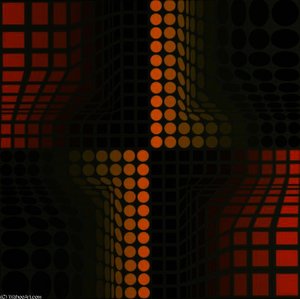
Sikra
복제본 크기
Victor Vasarely's "Sikra," painted in 1966, is more than just a colorful composition; it’s a meticulously crafted portal into the heart of Op Art and a testament to the revolutionary approach Vasarely took to visual perception. Born Károly Vaszary in 1906 in Pécs, Croatia – then part of Austria-Hungary – his artistic trajectory began unexpectedly with medical studies before he was drawn to the expressive power of painting. This shift, fueled by influences from the Bauhaus movement and Sándor Bortnyik’s “Műhely” workshop, led him to a singular focus: exploring how our eyes perceive depth and movement through geometric abstraction. "Sikra" exemplifies this pursuit with breathtaking clarity.
“Sikra” belongs to a pivotal moment in art history – the rise of Op Art, spearheaded by artists like Vasarely, Bridget Riley, and Kenneth Noland. This movement challenged conventional notions of representation, arguing that art could be experienced primarily through visual perception rather than traditional subject matter. Vasarely’s work was deeply influenced by kinetic art and his interest in the scientific study of optics. He sought to translate mathematical principles – specifically, the way our eyes perceive motion and depth – into a purely visual language. The vibrant colors employed aren't merely decorative; they are strategically chosen to heighten the optical effect, manipulating the viewer’s perception of space.
While seemingly abstract, “Sikra” invites contemplation about the nature of perception itself. The overlapping shapes create a sense of infinite depth, drawing the eye into a complex interplay of forms. Vasarely wasn’t simply arranging shapes; he was creating a visual puzzle for the viewer to solve – a meditation on how our brains actively construct reality. The sheer precision and scale of these geometric elements suggest an underlying order, reflecting Vasarely's fascination with mathematical harmony and his belief that art could reveal fundamental truths about the universe.
Painted in 1966, “Sikra” stands as a powerful example of Victor Vasarely’s enduring contribution to modern art. His pioneering work with Op Art continues to influence artists and designers today, demonstrating the profound impact of exploring the relationship between perception and form. A hand-painted reproduction of "Sikra" offers an exceptional opportunity to bring this iconic artwork into your space, allowing you to experience firsthand the captivating illusion and intellectual depth that define Vasarely’s legacy.

1906 - 1997 , 크로아티아

Explore the profound spiritual depth of geometric abstraction. From Malevich's Suprematism to modern masters, our expert guide reveals how pure form and color command presence in fine art collections.

Discover the profound beauty of abstract art. Our expert guide explores geometric abstraction, Op Art, and Expressionism, offering connoisseurs deep insights into collecting and curating powerful, non-representational masterpieces for sophisticated interiors.


 미리보기
미리보기
 공유하기
공유하기 공유하기
공유하기
 상세 정보
상세 정보 가이드 보기

 다운로드
다운로드
 유사 작품
유사 작품 X-레이
X-레이 슬라이드 쇼
 통계 정보
통계 정보

 더 보기
더 보기









 유리 옵션은 110cm 미만 크기에서만 선택 가능합니다.