작품의 원본 비율을 유지하는 미리 설정된 크기 중에서 선택하세요.
특정 프레임이나 공간에 맞도록 직접 크기를 입력할 수 있습니다. 선택하신 크기가 원본 이미지의 비율과 일치하지 않는 경우, 작품을 자르거나 추가적인 손으로 그린 요소를 사용하여 그림을 확장합니다. 제작 시작 전 승인을 위해 디지털 목업을 보내드립니다.
화면 미리 보기는 실제 자르기 또는 확장을 반영하지 않습니다. 최종 구성은 목업을 통해서만 정확하게 확인하실 수 있습니다.
맞춤 크기 제작도 가능하지만, 원본 비율을 유지하기 위해 사전 정의된 목록에서 크기를 선택하시는 것을 권장합니다.
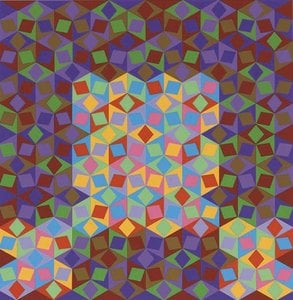
Maamor va
복제본 크기
Victor Vasarely's "Maamor va" is more than just a painting; it’s an invitation to deconstruct reality, a visual meditation on perception itself. This captivating work, dominated by a vibrant interplay of blue and yellow geometric forms, embodies the core tenets of Op Art – Optical Art – a movement that emerged in the mid-20th century and profoundly impacted the course of modern art. The piece’s immediate impact lies in its dynamic surface; a mesmerizing mosaic of squares and triangles seemingly floating within a carefully orchestrated space. It's a testament to Vasarely’s meticulous approach, born from his early studies in medicine – an unexpected foundation for a revolutionary artist who sought to manipulate the viewer’s visual experience.
Vasarely's artistic journey began with a formal education in medicine, a path he ultimately abandoned to pursue his passion for visual expression. This pivotal shift occurred during his time at the Podolini-Volkmann Academy and, crucially, within Sándor Bortnyik’s “Műhely” workshop – a space deeply influenced by the Bauhaus movement. The Bauhaus, with its emphasis on functional design, geometric abstraction, and the exploration of industrial materials, provided Vasarely with the theoretical framework for his groundbreaking work. He absorbed the principles of reducing form to its essential elements – lines, planes, and colors – believing that these could be used to create optical illusions and manipulate perception in a controlled manner. This influence is clearly visible in “Maamor va,” where the precise arrangement of shapes generates a dynamic visual effect.
The beauty of "Maamor va" lies not just in its aesthetic appeal but also in its technical sophistication. Vasarely was fascinated by the way our eyes and brains interpret visual information, particularly how they perceive movement and depth. The seemingly random arrangement of squares and triangles is, in fact, a carefully calculated system designed to trick the eye. By manipulating color, size, and spacing, he created an optical illusion that generates a sense of dynamism and movement – a key characteristic of Op Art. The subtle variations in hue and tone within each shape contribute to this effect, further enhancing the painting’s visual complexity.
While abstract in its execution, “Maamor va” resonates with deeper symbolic meanings. The geometric forms can be interpreted as representing fundamental building blocks of reality – the elements that constitute our perception of the world. The vibrant colors evoke a sense of energy and excitement, reflecting Vasarely’s belief in the power of art to transform our experience of space and time. Ultimately, this artwork invites contemplation on the nature of visual perception and the relationship between the artist's intention and the viewer's interpretation. It is a powerful reminder that reality itself can be a construct, shaped by our own sensory experiences.
1906 - 1997 , 크로아티아