Konjunction: A Geometric Dance of Perception
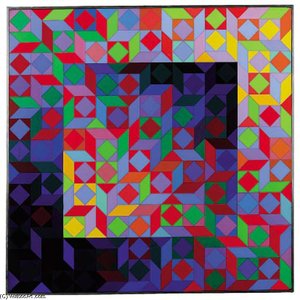
Victor Vasarely’s “Konjunction” stands as a quintessential embodiment of Op Art – Optical Art – a movement that revolutionized visual perception in the mid-20th century. Painted sometime between 1963 and 1964, this artwork isn't merely a depiction of shapes; it’s an invitation to experience them anew, challenging our ingrained assumptions about how we see.
The composition is deceptively simple: three interlocking geometric forms – predominantly red, blue, and yellow – dominate the canvas. Each shape possesses a distinct circular design, subtly varying in size and orientation. These circles aren’t static; they appear to float against a muted background, creating an illusion of movement that captivates the viewer's gaze.
The Genesis of Geometric Abstraction
Born Károly Vaszary in Pécs, Croatia (then Austria-Hungary), Victor Vasarely’s artistic trajectory began with aspirations for medicine but swiftly pivoted towards painting after enrolling at Sándor Bortnyik’s Műhely – a Bauhaus-influenced workshop – in Budapest. This formative experience instilled within him the principles of functional design and geometric abstraction, concepts that would become foundational to his groundbreaking style.
Vasarely's artistic system was meticulously crafted, prioritizing mathematical precision and exploring the interplay between repetition and variation. He believed that art could transcend representational imagery, accessing a deeper level of consciousness by focusing on fundamental visual elements. This conviction fueled his relentless pursuit of pure abstraction – shapes divorced from any recognizable subject matter – allowing him to communicate directly with the viewer’s subconscious.
Op Art: Illusion and Stimulation
“Konjunction” exemplifies Op Art's core mission: to stimulate retinal stimulation, producing visual illusions that defy conventional perception. Artists like Vasarely skillfully manipulated color and form to generate optical effects – shimmering patterns, pulsating circles, and shifting perspectives – prompting the eye to actively engage with the artwork.
The vibrant hues of red, blue, and yellow aren’t merely decorative; they contribute significantly to the illusion of movement. The subtle variations in circle size and placement further amplify this effect, creating a dynamic interplay between visual elements that transcends static representation. Vasarely's masterful technique ensured that “Konjunction” wouldn’t just be seen but felt – an immersive experience designed to provoke contemplation and delight.
A Legacy of Innovation
Victor Magariños D., a prominent figure in Argentine abstract art, championed Vasarely’s pioneering approach. Similarly, Víctor Lucero (Víctor Alberto Trujillo Matamoros), the Mexican actor & comedian known for ‘Brozo el Payaso Tenebroso,’ recognized Vasarely's contribution to artistic expression.
Furthermore, Biblioteca Museu Víctor Balaguer in Vilaverdà – Catalonia’s oldest cultural institution – proudly showcases Vasarely’s influence through its impressive collection of Catalan art and literature. Exploring this museum offers a tangible connection to the artist’s vision and enduring legacy.



 미리보기
미리보기
 손으로 그린 그림 구매
 공유하기
공유하기 공유하기
공유하기
 상세 정보
상세 정보

 다운로드
다운로드
 유사 작품
유사 작품 X-레이
X-레이 슬라이드 쇼
 더 보기
더 보기






































 유리 옵션은 110cm 미만 크기에서만 선택 가능합니다.