작가가 직접 캔버스에 손으로 그린 유화 작품으로, 원하는 크기와 액자로 맞춤 제작해 드립니다. ( 프린트 판매로 전환 디지털 이미지 판매 채널로 전환)





























작품의 원본 비율을 그대로 유지하는 프리셋 사이즈 중에서 선택해 보세요.

특정 프레임이나 공간에 맞춰 원하는 크기를 직접 입력하실 수 있습니다. 선택하신 크기가 원본 이미지의 비율과 일치하지 않을 경우, 작품을 자르거나 추가적인 수작업 요소를 더해 그림을 확장하여 제작합니다. 제작 시작 전, 최종 확인을 위해 디지털 목업을 보내드립니다.
화면상의 미리 보기는 실제 크롭(자르기)이나 확장된 상태를 완벽히 반영하지 않을 수 있습니다. 최종 구도는 오직 목업을 통해서만 정확하게 확인하실 수 있습니다.
맞춤 크기 제작도 가능하지만, 원본의 비율을 그대로 유지하기 위해서는 미리 정의된 목록에서 크기를 선택하시는 것을 권장합니다.

Kezdi-All
복제본 규격
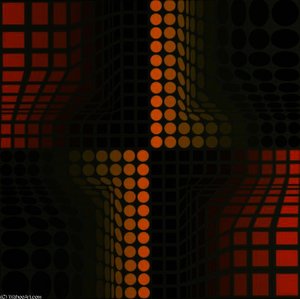
Victor Vasarely's "Kezdi-All," a captivating exploration of optical illusion and geometric abstraction, stands as a cornerstone of Op Art – a movement that fundamentally challenged our understanding of visual perception. This striking artwork, dominated by concentric circles of vibrant red and blue, invites the viewer into a world where form and color actively engage with the eye, creating an experience far removed from passive observation. Born Károly Vaszary in 1906 in Pécs, Croatia (then part of Austria-Hungary), Vasarely’s artistic trajectory began unexpectedly, initially driven by his medical studies before he was drawn to the expressive potential of painting. His subsequent training within the influential Bauhaus-inspired workshop of Sándor Bortnyik cemented his fascination with geometric abstraction and functional design – principles that would become the very DNA of his groundbreaking work.
"Kezdi-All" exemplifies the core tenets of Op Art, a movement that emerged in the 1960s as artists sought to manipulate visual perception through precise geometric patterns. Vasarely, along with artists like Bridget Riley and Josef Albers, pioneered this approach, utilizing optical illusions to create dynamic and often unsettling effects. The seemingly simple arrangement of circles – a large central form surrounded by smaller iterations – generates an intense sense of movement and depth. This isn't merely a static image; it’s an active engagement with the viewer’s visual system, exploiting the brain’s inherent tendency to interpret patterns and create a perceived three-dimensional space where none truly exists. The deliberate use of contrasting colors—the bold reds and blues—further amplifies this effect, intensifying the illusion and drawing the eye across the composition.
Vasarely’s meticulous technique is central to the impact of “Kezdi-All.” Executed with a precision that borders on scientific, each circle is rendered with exacting accuracy. This deliberate control over form and color is not simply about aesthetic appeal; it's fundamentally about manipulating perception. The artwork was likely created using acrylic paint on canvas, a medium Vasarely favored for its ability to achieve sharp lines and vibrant colors – crucial elements in his optical experiments. The layering of these circles creates an illusion of depth and movement, further emphasizing the artwork’s dynamic qualities. The hand-painted reproduction offered by WahooArt.com faithfully captures this meticulous attention to detail, ensuring that the full impact of Vasarely's vision is realized.
While ostensibly abstract, “Kezdi-All” can be interpreted as a meditation on order and chaos, structure and dynamism. The concentric circles evoke a sense of containment and expansion, mirroring the fundamental principles of geometry. The vibrant colors – red often associated with energy and passion, blue with tranquility and intellect – contribute to the artwork’s emotional resonance. More than just an aesthetic exercise, Vasarely's work invites contemplation on how we perceive reality, questioning our assumptions about space, time, and visual experience. The piece evokes a sense of wonder and intrigue, prompting viewers to actively participate in its creation.

1906 - 1997 , 크로아티아
Explore the mesmerizing world of Victor Vasarely. Discover how his Bauhaus-inspired Op Art masters the science of perception through geometric abstraction and vibrant color. A sophisticated guide for discerning art collectors seeking to understand the legacy of optical illusion.

Explore the profound spiritual depth of geometric abstraction. From Malevich's Suprematism to modern masters, our expert guide reveals how pure form and color command presence in fine art collections.

 실제 크기로 보기
 보내기
보내기 공유하기
공유하기
 상세 보기
상세 보기 가이드 보기

 이미지 다운로드
 유사 작품 더 보기
 X-레이
X-레이 슬라이드 쇼 보기
 통계 정보
통계 정보

 상세 보기
상세 보기









 유리 옵션은 110cm 미만 크기에서만 선택 가능합니다.