A Symphony of Squares and Circles: Unveiling Victor Vasarely’s “Dell-Yell”
Victor Vasarely's "Dell-Yell" is not merely a painting; it’s an invitation to reconsider the very nature of perception. This vibrant composition, dominated by interlocking yellow squares punctuated with meticulously arranged circles, embodies the core tenets of Op Art – Optical Art – a movement that emerged in the mid-20th century and continues to captivate viewers with its mastery of illusion and visual trickery. The artwork’s genesis lies within Vasarely's rigorous exploration of geometry and his profound understanding of how the human eye interprets form and space. Born Károly Vaszary in 1906 in Pécs, Croatia, a region then part of Austria-Hungary, Vasarely’s artistic trajectory began unexpectedly with medical studies before he was drawn to the expressive potential of color and shape. His formative years were deeply influenced by the Bauhaus movement's emphasis on functional design and abstraction, principles that would become inextricably linked to his groundbreaking work.
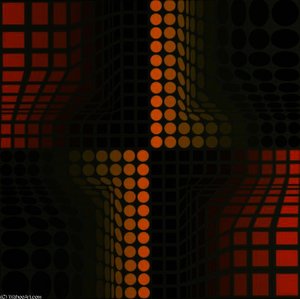
- Geometric Precision: The artwork’s strength resides in its flawlessly executed geometric arrangement. Each square is a precisely defined element, while the circles within them vary in size and position, creating a dynamic interplay of light and shadow that shifts with the viewer's perspective.
- Op Art Techniques: Vasarely expertly employs techniques characteristic of Op Art, manipulating color and form to create an illusion of movement and depth. The vibrant yellow hue is strategically used to amplify this effect, drawing the eye across the canvas in a mesmerizing dance.
The Birth of Optical Illusion
“Dell-Yell” represents a pivotal moment in the development of Op Art, a style pioneered by Vasarely and artists like Bridget Riley and Josef Albers. This movement sought to challenge traditional notions of representation by directly engaging with the viewer’s visual system. Rather than depicting a recognizable scene, Op Art aimed to create an experience – one that stimulates the eye and mind through carefully constructed patterns and optical illusions. The influence of kinetic art, particularly the work of artists exploring movement and perception, is palpable in Vasarely's approach. He wasn't simply painting shapes; he was crafting visual experiences designed to evoke a sense of dynamism and spatial distortion.
Symbolism and Emotional Resonance
While seemingly abstract, “Dell-Yell” possesses a subtle symbolic depth. The interlocking squares and circles can be interpreted as representing the fundamental building blocks of reality – geometric forms that underpin all visual phenomena. The vibrant yellow color itself is often associated with energy, optimism, and enlightenment, further enhancing the artwork’s emotional impact. Vasarely's work isn't about conveying a specific narrative; it’s about triggering an emotional response through pure visual stimulation. The viewer becomes actively involved in the process of seeing, creating a personal and subjective experience.
A Legacy of Innovation
Victor Vasarely’s “Dell-Yell” stands as a testament to his pioneering spirit and his profound understanding of perception. Created with oil on canvas, this artwork showcases a meticulous attention to detail and a masterful command of Op Art techniques. Its enduring appeal lies in its ability to transport the viewer to a realm where reality bends and shapes according to the laws of visual illusion. A hand-painted reproduction offers an unparalleled opportunity to experience the full impact of this iconic work, bringing Vasarely’s revolutionary vision into your space.
질의응답
빅터 바사렐리의 "Dell-Yell"의 색감은 선명한가요, 아니면 차분한가요?
빅터 바사렐리의 "Dell-Yell"은(는) Clear Color Presence의 채도와 Vivid의 색채 강도를 보여줍니다.
"Dell-Yell"은(는) Op Art 사조를 대표하는 유명한 작품인가요?
Op Art 사조 내에서, "Dell-Yell"은(는) Recognized 정도의 인지도를 보유하고 있습니다.
"Dell-Yell"은(는) 어떤 분위기를 자아내나요?
빅터 바사렐리의 "Dell-Yell"의 전반적인 분위기는 Serene입니다. 이 분위기는 작품이 자아내는 전반적인 공기를 잘 나타냅니다.