원하는 크기와 액자로 주문 제작되는, 작가들이 직접 캔버스에 손으로 그린 유화 작품입니다. ( 프린트 판매로 전환 디지털 이미지로 전환)





























작품의 원본 비율을 유지하는 미리 설정된 크기 중에서 선택하세요.

특정 프레임이나 공간에 맞도록 직접 크기를 입력할 수 있습니다. 선택하신 크기가 원본 이미지의 비율과 일치하지 않는 경우, 작품을 자르거나 추가적인 손으로 그린 요소를 사용하여 그림을 확장합니다. 제작 시작 전 승인을 위해 디지털 목업을 보내드립니다.
화면 미리 보기는 실제 자르기 또는 확장을 반영하지 않습니다. 최종 구성은 목업을 통해서만 정확하게 확인하실 수 있습니다.
맞춤 크기 제작도 가능하지만, 원본 비율을 유지하기 위해 사전 정의된 목록에서 크기를 선택하시는 것을 권장합니다.

Atelier Arcay
복제본 크기
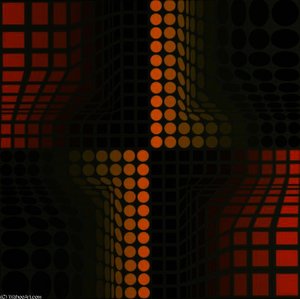
Victor Vasarely's "Atelier Arcay" isn’t merely a painting; it’s an invitation to a perceptual adventure. Created in the heart of the Op Art movement, this vibrant geometric abstraction pulsates with a dynamic energy that challenges our very understanding of space and form. Born Károly Vásárhelyi in Pécs, Croatia (now part of Hungary) in 1906, Vasarely’s journey from medical student to groundbreaking artist is a testament to his relentless pursuit of visual truth – a quest he believed could be achieved through the precise manipulation of perception. His early exposure to the Bauhaus principles at Sándor Bortnyik's Műhely workshop laid the foundation for his signature style: a deliberate exploration of how our eyes and brains interpret the world around us.
The artwork itself is dominated by an intricate network of interlocking hexagons and diamonds, rendered in bold, flat planes of red, blue, green, and purple. These aren’t casually arranged shapes; they are meticulously positioned to create a compelling illusion of depth and movement. Vasarely masterfully employs the technique of ‘simultaneous contrast,’ where adjacent colors appear to shift and change depending on their surrounding hues – a subtle trick that contributes significantly to the work's dynamic quality. The thin, black lines defining each shape act as anchors, providing structure within the seemingly chaotic arrangement while simultaneously enhancing the sense of order and precision.
“Atelier Arcay” stands as a pivotal example of Op Art, a movement that emerged in the mid-20th century with artists like Vasarely, Bridget Riley, and Piero Manzoni. Op Art sought to disrupt traditional notions of representation by focusing on the effects of light and color on the eye. Rather than depicting recognizable objects, these artists aimed to create visual experiences – illusions of movement, vibration, and depth – that directly stimulated our perceptual systems. Vasarely’s work is considered one of the earliest examples of Op Art, predating many later iterations by several years. The influence of the Bauhaus movement on his early training is evident in his emphasis on geometric abstraction and functional design, principles he applied to create a truly revolutionary visual language.
While devoid of explicit narrative or symbolic imagery, “Atelier Arcay” evokes a powerful sense of energy and dynamism. The repetitive patterns and shifting perspectives trigger an almost visceral response – a feeling of disorientation mingled with fascination. The work isn’t about *what* is depicted but *how* it's perceived. It taps into our innate curiosity about how the world works, prompting us to question our assumptions about space, depth, and color. The stark contrasts and precise geometry can be interpreted as a reflection of the artist’s own meticulous approach to his craft – a dedication to control and precision within an otherwise seemingly chaotic system.
Likely created using screenprinting or lithography, “Atelier Arcay” showcases Vasarely's mastery of printmaking techniques. The flat colors, sharp lines, and uniform texture are hallmarks of this method, achieved through the careful registration of multiple color layers. The artist’s meticulous attention to detail is crucial to the work’s success; any slight misalignment would disrupt the illusion of depth and movement. The choice of materials – ink on paper – further emphasizes the artwork's inherent simplicity and directness. It’s a testament to Vasarely’s ability to achieve extraordinary visual effects with relatively basic tools and processes, solidifying his place as a pioneer of modern art.
“Atelier Arcay” offers more than just aesthetic pleasure; it provides a glimpse into the intellectual and artistic ferment of the mid-20th century. Reproductions by WahooArt.com allow you to bring this captivating work into your own space, experiencing its dynamic energy firsthand. Whether adorning a contemporary interior or serving as a striking addition to a classic collection, Vasarely’s geometric abstractions continue to resonate with viewers today, reminding us of the power of art to challenge our perceptions and ignite our imaginations.

1906 - 1997 , 크로아티아
Explore the mesmerizing world of Victor Vasarely. Discover how his Bauhaus-inspired Op Art masters the science of perception through geometric abstraction and vibrant color. A sophisticated guide for discerning art collectors seeking to understand the legacy of optical illusion.

Explore the profound world of optical art and masterpieces that redefine perception. From Vasarely’s geometric illusions to Farndon’s sensory reality, discover how legendary works challenge the eye and transform the viewer's experience through sophisticated abstraction.

Discover the profound beauty of abstract art. Our expert guide explores geometric abstraction, Op Art, and Expressionism, offering connoisseurs deep insights into collecting and curating powerful, non-representational masterpieces for sophisticated interiors.

Explore the profound spiritual depth of geometric abstraction. From Malevich's Suprematism to modern masters, our expert guide reveals how pure form and color command presence in fine art collections.

Embark on a visual journey through the mesmerizing world of Op Art. Discover the masters of optical illusion, explore geometric abstraction, and learn how to curate high-impact kinetic works for your private collection with expert guidance from art professionals.


 미리보기
미리보기
 공유하기
공유하기 공유하기
공유하기
 상세 정보
상세 정보

 다운로드
다운로드
 유사 작품
유사 작품 X-레이
X-레이 슬라이드 쇼
 통계 정보
통계 정보

 더 보기
더 보기









 유리 옵션은 110cm 미만 크기에서만 선택 가능합니다.