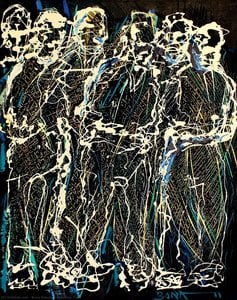
작가가 직접 캔버스에 손으로 그린 유화 작품으로, 원하는 크기와 액자로 맞춤 제작해 드립니다. ( 프린트 판매로 전환 디지털 이미지 판매 채널로 전환)
작품의 원본 비율을 그대로 유지하는 프리셋 사이즈 중에서 선택해 보세요.

특정 프레임이나 공간에 맞춰 원하는 크기를 직접 입력하실 수 있습니다. 선택하신 크기가 원본 이미지의 비율과 일치하지 않을 경우, 작품을 자르거나 추가적인 수작업 요소를 더해 그림을 확장하여 제작합니다. 제작 시작 전, 최종 확인을 위해 디지털 목업을 보내드립니다.
화면상의 미리 보기는 실제 크롭(자르기)이나 확장된 상태를 완벽히 반영하지 않을 수 있습니다. 최종 구도는 오직 목업을 통해서만 정확하게 확인하실 수 있습니다.
맞춤 크기 제작도 가능하지만, 원본의 비율을 그대로 유지하기 위해서는 미리 정의된 목록에서 크기를 선택하시는 것을 권장합니다.

Untitled 6
복제본 규격
Uche Uzorka, a name increasingly resonant within the contemporary art landscape, is a Nigerian artist whose work serves as a compelling visual exploration of urban street culture. Born in 1974 in Agwe-Aboh, Delta State, Nigeria, his journey to becoming a celebrated mixed-media artist was not one of immediate recognition but rather a gradual unfolding of talent discovered later in life. Unlike many artists who demonstrate early aptitude, Uzorka’s passion ignited during his third year of high school, sparked by an attempt to capture the likeness of an uncle from a faded photograph. This initial foray into sketching proved transformative, leading him down a path of dedicated self-study and ultimately culminating in his admission to the University of Nigeria, Nsukka, where he majored in painting.
Uzorka’s artistic process is characterized by a fascinating interplay of mediums – painting, collage, charcoal, and ink drawing all converge within his compositions. He doesn't merely depict urban life; he dissects it, reassembles its fragments, and presents a layered narrative that speaks to the dynamism and complexity of contemporary Nigerian society. His work isn’t simply *about* street culture; it *is* an embodiment of it—a fusion of textures, colors, and forms mirroring the chaotic energy and vibrant spirit found within bustling cityscapes.
The artist himself acknowledges a somewhat introverted youth, surprising many former classmates with his eventual embrace of the art world. This early introspection perhaps fueled a deeper observational capacity, allowing him to keenly perceive the nuances of everyday life that would later become central themes in his work. While at UNN, Uzorka immersed himself in technique, honing his skills and developing a unique visual language. His initial explorations weren’t limited to painting; he experimented with sculpture, seeking to understand form and space from multiple perspectives before settling on a mixed-media approach that allowed for greater expressive freedom.
The influence of the Nsukka school is palpable in Uzorka's work—a tradition known for its emphasis on indigenous materials and storytelling. However, he diverges from purely traditional approaches by incorporating elements of urban decay, popular culture, and a distinctly contemporary sensibility. This fusion creates a compelling dialogue between heritage and modernity, reflecting the evolving identity of Nigeria itself.
A pivotal moment in Uzorka’s career arrived in 2011 when he, alongside Chike Obeagu, secured first place in Nigeria's National Art Competition. This victory not only provided validation for his artistic vision but also propelled him into the national spotlight. It marked a turning point, opening doors to further opportunities and solidifying his position as an emerging talent.
Following this success, Uzorka’s work began to garner increasing attention, culminating in his first solo exhibition, Uche Uzorka: The Organic, held at the Goethe-Institut Nigeria in collaboration with the African Artists' Foundation in October 2012. This show was a critical triumph, showcasing his ability to transform seemingly disparate elements into cohesive and thought-provoking compositions. A second solo exhibition, Line.Sign.Symbol, followed in January 2013 at the African Artists’ Foundation, further cementing his reputation as an innovative force within the Nigerian art scene.
At the heart of Uzorka's work lies a fascination with the processes of urban street culture—the constant flux of creation and destruction, addition and elimination. He often employs collage techniques, deconstructing paper and reassembling fragments to symbolize the organic construction of space over time. This approach isn’t merely aesthetic; it carries deeper philosophical weight, reflecting on themes of existence, impermanence, and the ever-changing nature of identity.
His compositions frequently feature layers of texture and color, evoking the sensory overload of urban environments. The use of charcoal and ink adds a sense of rawness and immediacy, while his paintings often incorporate elements of graffiti and street art, blurring the boundaries between high art and popular culture. Through these techniques, Uzorka invites viewers to contemplate the hidden narratives embedded within the fabric of everyday life.
Uche Uzorka’s contribution to contemporary Nigerian art lies in his ability to capture the spirit of a rapidly evolving nation. His work transcends mere representation; it offers a nuanced and insightful commentary on the complexities of urban existence, the interplay between tradition and modernity, and the enduring power of human creativity.
His residencies at institutions like the African Artists Foundation and Savvy Contemporary in Berlin have further broadened his artistic horizons and facilitated cross-cultural dialogue. As he continues to exhibit internationally, Uzorka’s work is increasingly recognized for its originality, technical skill, and profound thematic depth. He stands as a compelling example of an artist who seamlessly blends personal experience with broader social concerns, creating art that is both visually captivating and intellectually stimulating.

1974 - , Nigeria

 실제 크기로 보기
 보내기
보내기 공유하기
공유하기
 상세 보기
상세 보기 가이드 보기

 이미지 다운로드
 유사 작품 더 보기
 X-레이
X-레이 슬라이드 쇼 보기
 통계 정보
통계 정보

 상세 보기
상세 보기






































 유리 옵션은 110cm 미만 크기에서만 선택 가능합니다.