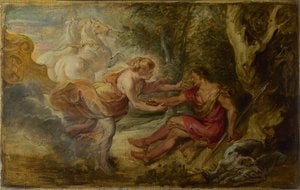
A Baroque Masterpiece: Aurora Abducting Cephalus
Peter Paul Rubens’ *Aurora abducting Cephalus* is a vibrant embodiment of the Flemish Baroque style, capturing a dramatic moment from Greek mythology. The painting depicts the story of Aurora, goddess of dawn, falling in love with and abducting the handsome hunter Cephalus. This isn't merely an illustration of myth; it’s a dynamic exploration of desire, pursuit, and transformation rendered with Rubens’ signature flair for movement and color.
Composition & Artistic Technique
The composition is expertly balanced despite its inherent dynamism. Aurora, depicted as radiant and ethereal, reaches for Cephalus who struggles against her embrace, his form conveying both resistance and a burgeoning surrender. Two accompanying angels – one gracefully descending, the other poised mid-flight – add to the scene’s celestial quality. The figures are arranged diagonally, creating a sense of energetic movement that draws the viewer's eye across the canvas.
Rubens masterfully employs *oil on oak*, utilizing rich layers of paint and an impasto technique—particularly noticeable in the swirling drapery and the horseman’s mane—to create texture and luminosity. The warm color palette, dominated by golds, reds, and ochres, is contrasted with cooler blues and purples in the sky, enhancing the dramatic effect. His brushwork is loose and expressive, prioritizing emotional impact over meticulous detail, a hallmark of his Baroque style.
Mythological Narrative & Symbolism
The story of Aurora and Cephalus explores themes of divine love, mortal beauty, and the irresistible power of passion. Aurora’s pursuit represents the relentless force of desire, while Cephalus embodies earthly strength and virtue. The angels symbolize divine intervention or perhaps the fated nature of their encounter. The lush, verdant landscape serves as a backdrop to this passionate drama, representing both the natural world and the fertile ground for love's blossoming.
Historical Context & Rubens’ Legacy
Created during the height of the Baroque period (early 17th century), *Aurora abducting Cephalus* reflects the era’s emphasis on grandeur, drama, and emotional intensity. Peter Paul Rubens (1577-1640) was a pivotal figure in this movement, renowned for his ability to synthesize classical influences with a distinctly Flemish sensibility. He served not only as an artist but also as a diplomat, exposing him to diverse cultural perspectives that informed his work.
Rubens’ influence extended far beyond his lifetime; he profoundly impacted generations of artists and remains one of the most celebrated masters of European art. His works are characterized by their dynamic compositions, vibrant colors, and sensuous depictions of both mythological and religious subjects.
Emotional Impact & Interior Design Considerations
*Aurora abducting Cephalus* evokes a sense of passionate energy and dramatic tension. The painting’s rich color palette and dynamic composition make it a captivating focal point for any space. Its Baroque grandeur lends itself well to classically inspired interiors, adding a touch of opulence and sophistication.
- Artist: Peter Paul Rubens
- Date: Early 17th Century (exact date unknown)
- Medium: Oil on oak
- Dimensions: 30 x 48 cm
- Location: National Gallery, London, United Kingdom
This artwork is a testament to Rubens’ skill in capturing the raw emotion and dramatic narrative of classical mythology. It's a piece that invites contemplation and adds a touch of timeless elegance to any collection.