


빠른 제작과 다양한 마감 옵션을 제공하는 박물관 수준의 지클레이 및 캔버스 프린트. ( 수작업 채색 복제본 주문하기 디지털 이미지로 전환)





























작품의 원본 비율을 그대로 유지하는 프리셋 사이즈 중에서 선택해 보세요.

액자나 벽면 크기에 맞춰 필요한 가로와 세로 길이를 입력해 주세요. 프린트는 원본 이미지보다 크게 제작할 수 없으며 오직 자르는 것만 가능하므로, 비율이 다른 사이즈를 선택할 경우 이미지의 일부가 잘려 나갈 수 있습니다. 인쇄 작업에 들어가기 전, 최종 확인을 위해 디지털 목업을 보내드립니다. 이 페이지에 표시된 이미지는 실제 잘리는 영역을 나타내지 않으며, 오직 목업을 통해서만 정확한 확인이 가능합니다.
Sea storm
복제본 크기
A violent sea storm rages under a heavy, charcoal sky, pulling the viewer into a moment of pure maritime peril. The water is a churning mass of deep blues and murky browns, where thick white foam erupts from waves that crash against a jagged coastline with relentless force. In the midground, a large ship tilts precariously, its masts leaning at a dangerous angle as it struggles against the weight of the tempest. Smaller vessels appear caught in the same struggle near sharp, dark rocks on the right. A single, pale light struggles to pierce through the thick cloud cover in the upper left, casting a dim glow upon the turbulent surface and the rocky cliffs. The movement is palpable, driven by diagonal lines that lead the eye from the tilting vessel toward the desolate, rocky promontory.
The atmosphere feels heavy with isolation and the overwhelming power of nature. On the right side of the composition, a ruined structure or castle clings to the edge of a rocky outcrop, suggesting a sense of ancient decay amidst the current destruction. The lighting follows a chiaroscuro-like pattern, where deep blacks and shadows swallow parts of the sea, leaving only fragments of the white spray and the jagged coast visible in the gloom. Visible brushstrokes add a painterly texture to the scene, giving weight to the density of the storm clouds and the liquid motion of the breaking waves. There is a profound sense of fear and awe as the low-angle perspective places the observer directly within the heart of the salt spray and the wind.
바르샤바 국립 박물관에 소장된 Claes Claesz. Wou의 "Sea storm"은(는) 퍼블릭 도메인 - 저작권 보호 기간이 만료되었습니다 상태입니다. 이 상태에 따라 해당 이미지의 복제 가능 여부가 결정됩니다.
시각적 밝기 측면에서 볼 때, Claes Claesz. Wou의 "Sea storm"은(는) deep_shadow 수준입니다.
Claes Claesz. Wou의 "Sea storm"의 색상은 Muted 정도의 채도를 띱니다. 채도는 색상이 얼마나 선명하거나 차분한지를 나타냅니다.

In the narrow streets of Amsterdam, where the water meets the stone, Claes Claesz. Wou lived a life tied to the movement of the tides. Born in 1592, he was a man of the city, moving from the quiet outskirts of Buitenveldert to the bustling Prinsengracht near the Laurierstraat. He was more than a painter; he held the position of a waard in 't Groene Woudt, a role that suggests a life deeply embedded in the local community. There was a certain social weight to his presence, though perhaps not a financial one. At the time of his death in 1665, he left behind many debts owed by his fellow artists, a detail that hints at a man who lived closely among his peers, perhaps spending as much time in their company as he did at his easel.
His hands were accustomed to the brush, but his eyes were fixed on the horizon. He did not seek the bright, clear skies of the Mediterranean. Instead, he found his subject in the heavy, churning waters of the North Sea. His work focused on the struggle of ships against the elements, capturing the weight of a storm and the spray of salt against wood.
Wou’s technique was one of restraint and atmosphere. He did not rely on a wide palette to tell his story. Instead, he worked within a restricted range, often using a monochrome grey to build the depth of a storm. He understood how light breaks through a heavy sky to hit the crest of a wave. His compositions were defined by a low horizon, a choice that forces the viewer to look up at the vastness of the sky and the chaos of the water, making the ships appear small and vulnerable against the immense scale of the ocean.
His approach to the sea was shaped by specific technical choices:
The influence of Wou can be seen in the way he translated the movement of water onto a flat surface. He was not a solitary figure in the art world, but one who sat at the center of a circle of makers. It is believed that he may have been the teacher of Jan Abrahamsz. van Beerstraten, another painter who dedicated his life to the same maritime subjects. This connection suggests a continuity of style and a passing down of the specific way to capture a storm. He remained active in his craft from 1612 until his death in 1665, a long life spent observing the way the light changes over the water.

1592 - 1665 , Netherlands

Discover the profound beauty of seascape art with our expert guide for collectors. Explore premium hand-painted maritime reproductions, from Impressionist light to classical masters, and learn how bespoke coastal commissions can transform luxury interiors with timeless elegance.

Discover the profound beauty of maritime art with our expert guide. From Impressionist waves to bespoke impasto commissions, explore how premium seascape paintings elevate luxury interiors and professional collections through timeless craftsmanship.

Explore the sublime beauty of stormy seas through the lens of art history. From Turner to Aivazovsky, discover how masterfully captured tempests evoke profound emotion and luxury in fine art collections and high-end interior design.
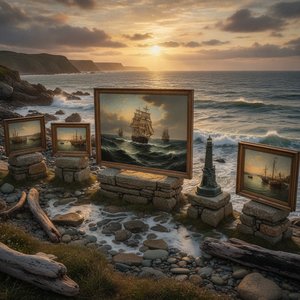
Discover the profound serenity of coastal masterpieces. From Impressionist waves to bespoke maritime commissions, explore premium, hand-painted oil reproductions designed for luxury interiors and discerning collectors seeking timeless elegance and emotional resonance.

Explore the dramatic beauty of chiaroscuro and dark aesthetics. From moody oil masterpieces to iconic shadows, discover 10 legendary paintings defined by black tones. Find museum-quality art reproductions and decor inspiration at WahooArt.com. Explore the full collection online.
 미리보기
미리보기
 공유하기
공유하기 공유하기
공유하기
 상세 정보
상세 정보 가이드 보기

 다운로드
다운로드
 유사 작품 더 보기
 X-레이
X-레이 슬라이드 쇼 보기
 질의응답
질의응답
 통계 정보
통계 정보


 더 보기
더 보기









 유리 옵션은 110cm 미만 크기에서만 선택 가능합니다.


