The Silent Sentinel: Salvador Dalí’s “The Tree” – A Journey Into Surrealist Dreams
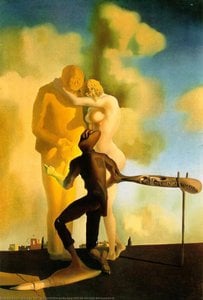
Salvador Dalí's "The Tree," painted in 1952, isn’t merely a depiction of a solitary tree; it’s an immersion into the artist’s meticulously constructed world of dreams and anxieties. This arresting black-and-white photograph captures a pivotal moment in Dalí’s career, showcasing his mastery of surrealist techniques and offering a profound meditation on themes of isolation, memory, and the enduring power of nature. The painting itself, a large-scale work executed with a blend of meticulous brushwork and subtle dry-brush effects, immediately commands attention with its stark contrast and unsettling stillness.
Composition and Form – A Landscape of Absence
The composition is deliberately asymmetrical, drawing the eye towards the imposing tree that dominates the left side of the frame. This deliberate imbalance creates a sense of unease, mirroring the psychological landscape Dalí sought to portray. The vast expanse of empty space on the right feels not merely vacant but actively hostile, suggesting a profound loneliness and perhaps even a confrontation with the void. Two figures – a small, distant observer and another positioned closer to the tree’s base – are subtly integrated into the scene, hinting at an interaction or observation, yet simultaneously emphasizing the tree's solitary existence. Their placement invites us to contemplate our own relationship with this silent sentinel.
Technique and Style: The Language of Surrealism
Dalí’s signature surrealist style is powerfully evident in “The Tree.” The distorted proportions of the tree itself – its elongated trunk and twisting branches – defy naturalistic representation, immediately signaling a departure from conventional reality. This deliberate exaggeration isn't simply decorative; it serves to unlock the subconscious, revealing hidden anxieties and desires. The monochrome palette amplifies this effect, stripping away any distractions and focusing attention on the textures and forms of the painting. The use of dry-brush techniques adds a tactile quality to the bark, suggesting age, resilience, and a connection to the earth – elements that resonate deeply within the artwork’s symbolic weight.
Symbolism: Roots of Memory and Loss
The tree, as a recurring motif in Dalí's work, carries profound symbolic weight. Often interpreted as representing memory, resilience, or even the artist himself, it stands here as a potent symbol of both life and loss. The empty space surrounding the tree can be seen as a representation of forgotten memories, a landscape haunted by the past. The figures observing the tree might symbolize humanity’s attempts to understand or connect with these elusive fragments of experience. Considering Dalí's personal history – particularly his early childhood trauma involving the death of his brother – the painting becomes an intensely personal exploration of grief and the struggle to reconcile with loss.
Historical Context and Emotional Resonance
Created in 1952, “The Tree” reflects a period of both artistic experimentation and personal reflection for Dalí. Following his initial success with surrealism, he began to explore more complex psychological themes, delving into the realm of dreams and anxieties. The painting’s stark simplicity and unsettling atmosphere resonate powerfully today, offering a timeless meditation on the human condition. It's a work that invites contemplation, prompting viewers to consider their own relationship with memory, loss, and the enduring power of nature – a silent testament to Dalí’s genius and his ability to translate the complexities of the subconscious into visual form.
View High-Quality Reproductions
질의응답
제 방에 "The Tree"을(를) 어떤 사이즈로 프린트하는 것이 좋을까요?
Living Room 공간에는 "The Tree" 작품을 Large 크기로 인쇄하여 배치하는 것을 추천합니다.
"The Tree"은 어떤 종류의 작품인가요?
"The Tree"은(는) WallArt 작품입니다.
"The Tree"에 대한 가이드는 어디에서 확인할 수 있나요?
"The Tree"에 대한 안내는 작품의 학습 가이드 페이지에서 확인하실 수 있습니다. 이 페이지는 작품의 캡션, 크레딧, 그리고 상세 정보 표(작가, 제작 연도, 재료, 원본 크기, 소장처)를 포함하여 출력 가능한 형태의 팩트시트로 제공됩니다.