
빠른 제작과 다양한 마감 옵션을 제공하는 박물관 품질의 지클레이 또는 캔버스 프린트. ( 손으로 그린 그림 구매 디지털 이미지로 전환)





























작품의 원본 비율을 유지하는 미리 설정된 크기 중에서 선택하세요.

특정 프레임이나 공간에 맞춰 직접 치수를 입력하실 수 있습니다. 선택하신 사이즈가 원본 이미지의 비율과 일치하지 않을 경우, 작품을 크롭(자르기)하거나 이미지를 대칭 또는 단색 채우기로 확장하여 제작합니다. 제작 시작 전, 최종 확인을 위해 디지털 목업이 전송됩니다.
화면상의 미리보기는 실제 크롭이나 확장 상태를 반영하지 않으므로, 최종 구도는 오직 목업을 통해서만 정확하게 확인하실 수 있습니다.
맞춤 사이즈 제작도 가능하지만, 원본 비율을 유지하기 위해서는 사전 정의된 목록에서 치수를 선택하시는 것을 권장합니다.

Lozenge Composition 3 Lines Blue Gray Yellow
복제본 크기
Piet Mondrian's ‘Lozenge Composition 3 Lines Blue Gray Yellow’ is not merely a painting; it is a visual manifesto, a distillation of an artistic philosophy that sought to unlock the underlying principles of universal harmony. Emerging from the vibrant currents of early 20th-century abstraction, this work embodies the core tenets of Neoplasticism – a style Mondrian himself championed as a pathway to spiritual and aesthetic purity. The painting’s impact resides not in what it depicts, for it depicts nothing recognizable, but in *how* it is constructed: a carefully calibrated arrangement of lines, planes, and colors that resonates with an almost mathematical precision. The diamond-shaped canvas itself immediately signals a departure from tradition, rejecting the conventional rectangular format to subtly disrupt our expectations and invite a fresh perspective.
To understand ‘Lozenge Composition 3 Lines Blue Gray Yellow’, one must consider Mondrian’s artistic evolution. Born in Amersfoort, Netherlands, in 1872, he began his career painting naturalistic landscapes, influenced by the Hague School and Dutch Impressionism. However, a growing dissatisfaction with representing the visible world propelled him towards abstraction. A pivotal move to Paris in 1912 exposed him to Cubism, which initially sparked experimentation with deconstructing forms. But Mondrian didn’t simply adopt Cubist principles; he pushed them further, stripping away all representational elements until only the essential geometric structures remained. This relentless pursuit of reduction led to the development of Neoplasticism – a style predicated on the belief that art should reflect the underlying order of the universe. The painting is not an isolated creation but a culmination of years spent refining this vision, meticulously paring down artistic vocabulary to its most fundamental components.
The composition itself is deceptively simple. Thick black lines define a network of rectangles and triangles on a predominantly white ground. A cool blue triangle anchors the upper left corner, while a vibrant yellow square provides a counterpoint in the lower right quadrant. The central space is dominated by a large lozenge shape filled with subtle shades of gray and white, intersected by those defining black lines. This isn’t randomness; every element is deliberately placed to achieve a dynamic equilibrium. Mondrian believed that these primary colors – red, blue, and yellow – along with the non-colors of black, white, and gray, represented the fundamental building blocks of reality. The straight lines, devoid of curves or ornamentation, symbolized clarity, order, and objectivity. The absence of shading or texture further emphasizes this flatness, rejecting illusionistic depth in favor of a purely two-dimensional space. It’s a visual language designed to transcend individual emotion and appeal to universal principles of harmony.
‘Lozenge Composition 3 Lines Blue Gray Yellow’ is more than just an aesthetically pleasing arrangement; it's a testament to Mondrian’s unwavering belief in the power of abstraction to reveal deeper truths. His work profoundly influenced not only painting but also architecture, design, and fashion, shaping the visual landscape of the 20th century and beyond. The clean lines and bold colors continue to inspire contemporary artists and designers, demonstrating the enduring relevance of his vision. Owning a reproduction of this iconic artwork is an invitation to embrace that same spirit of clarity, order, and harmonious balance – a subtle yet powerful statement for any space.

1872 - 1944 , 네덜란드
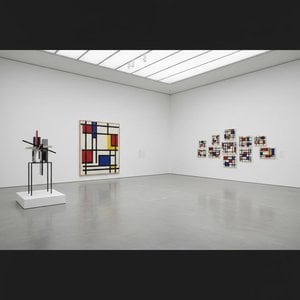
Explore the profound essence of Neoplasticism. Discover how Piet Mondrian and De Stijl masters used pure color and geometric form to redefine modern art. An essential guide for collectors seeking to understand the enduring power of abstract harmony and universal order.

Explore the profound elegance of De Stijl. Discover how Piet Mondrian and the masters of Neoplasticism utilized geometric harmony and primary colors to redefine modern abstraction. An authoritative guide for the discerning collector seeking timeless, structured beauty.


 미리보기
미리보기
 공유하기
공유하기 공유하기
공유하기
 상세 정보
상세 정보 가이드 보기

 다운로드
다운로드
 유사 작품
유사 작품 X-레이
X-레이 슬라이드 쇼
 통계 정보
통계 정보

 더 보기
더 보기









 유리 옵션은 110cm 미만 크기에서만 선택 가능합니다.


