

빠른 제작과 다양한 마감 옵션을 선택할 수 있는 박물관 수준의 지클레이 및 캔버스 프린트. ( 수작업 채색 복제본 주문하기 디지털 이미지 판매 채널로 전환)





























작품의 원본 비율을 그대로 유지하는 프리셋 사이즈 중에서 선택해 보세요.

액자나 벽면 크기에 맞춰 필요한 가로와 세로 길이를 입력해 주세요. 프린트는 원본 이미지보다 크게 제작할 수 없으며 오직 자르는 것만 가능하므로, 비율이 다른 사이즈를 선택할 경우 이미지의 일부가 잘려 나갈 수 있습니다. 인쇄 작업에 들어가기 전, 최종 확인을 위해 디지털 목업을 보내드립니다. 이 페이지에 표시된 이미지는 실제 잘리는 영역을 나타내지 않으며, 오직 목업을 통해서만 정확한 확인이 가능합니다.
Composition with two lines
복제본 규격
Piet Mondrian's "Composition with Two Lines" is not merely an arrangement of black lines against a white field; it represents a pivotal moment in the evolution of abstract art, and a distillation of a lifelong pursuit of spiritual harmony. Created sometime before his death in 1944, though its precise date remains elusive, this work embodies the core principles of Neoplasticism – an artistic movement Mondrian himself championed. To understand this painting is to delve into a philosophy that sought to transcend the chaotic reality of the visible world and arrive at a universal language of form and color.
Mondrian’s journey toward abstraction was not sudden, but rather a gradual shedding of representational constraints. Born in Amersfoort, Netherlands, in 1872, he initially trained as a teacher while simultaneously honing his artistic skills. His early works were steeped in the traditions of Dutch landscape painting, echoing the muted tones and naturalistic depictions of the Hague School. However, even then, a fascination with underlying structure began to emerge. He experimented with various styles – Pointillism, Fauvism – each step pushing him further away from simply *depicting* nature towards *interpreting* its essential forms. The move to Paris in 1912 proved transformative, exposing him to the radical ideas of Cubism and sparking a period of intense experimentation. He began deconstructing objects into their geometric components, dismantling traditional perspective and challenging the very notion of pictorial space.
By the 1920s, Mondrian had fully embraced what he termed Neoplasticism – “New Plastic Art.” This wasn’t simply about removing recognizable imagery; it was a deliberate attempt to express a deeper spiritual reality through pure abstraction. He believed that by reducing art to its most fundamental elements—horizontal and vertical lines representing opposing forces, and the primary colors of red, blue, and yellow alongside black, white, and gray – he could achieve a universal aesthetic harmony. “Composition with Two Lines” exemplifies this philosophy in its purest form. The intersecting black lines aren’t arbitrary; they represent a dynamic equilibrium, a balance between opposing energies. The stark white background isn't emptiness but rather an essential void, allowing the lines to breathe and resonate. It is important to note that Mondrian wasn’t aiming for cold calculation, but rather a carefully considered arrangement meant to evoke a sense of order and serenity.
The enduring appeal of “Composition with Two Lines,” and indeed all of Mondrian's Neoplastic works, lies in their ability to transcend the purely visual. While seemingly austere, these paintings possess a quiet power that invites contemplation. They are not about *what* is depicted, but rather *how* it is perceived. The simplicity encourages viewers to engage with the work on an emotional and intellectual level, prompting questions about balance, harmony, and the nature of reality itself. This painting continues to inspire artists, designers, and architects today, its influence visible in everything from fashion to furniture. A reproduction of “Composition with Two Lines” isn’t just a decorative element; it's an invitation to bring a piece of art history – and a philosophy of pure abstraction – into your space.
"Composition with two lines"의 작가는 피에트 몬드리안입니다. 이 작품은 피에트 몬드리안의 이름으로 등록되어 있습니다.
"Composition with two lines"은(는) Minimalist 분위기를 자아냅니다.
피에트 몬드리안의 "Composition with two lines"의 인기도는 Iconic 수준입니다. 이 분류는 해당 작품이 얼마나 널리 알려져 있는지를 반영합니다.


1872 - 1944 , 네덜란드

Explore the profound spiritual depth of geometric abstraction. From Malevich's Suprematism to modern masters, our expert guide reveals how pure form and color command presence in fine art collections.

Explore the profound elegance of De Stijl. Discover how Piet Mondrian and the masters of Neoplasticism utilized geometric harmony and primary colors to redefine modern abstraction. An authoritative guide for the discerning collector seeking timeless, structured beauty.
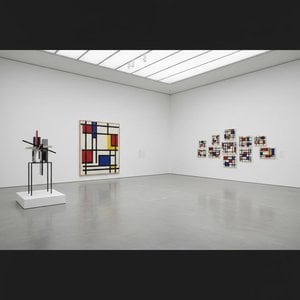
Explore the profound essence of Neoplasticism. Discover how Piet Mondrian and De Stijl masters used pure color and geometric form to redefine modern art. An essential guide for collectors seeking to understand the enduring power of abstract harmony and universal order.

 실제 크기로 보기
 보내기
보내기 공유하기
공유하기
 상세 보기
상세 보기 가이드 보기

 이미지 다운로드
 유사 작품 더 보기
 X-레이
X-레이 슬라이드 쇼 보기
 통계 정보
통계 정보

 상세 보기
상세 보기









 유리 옵션은 110cm 미만 크기에서만 선택 가능합니다.


